
(1854-1920)
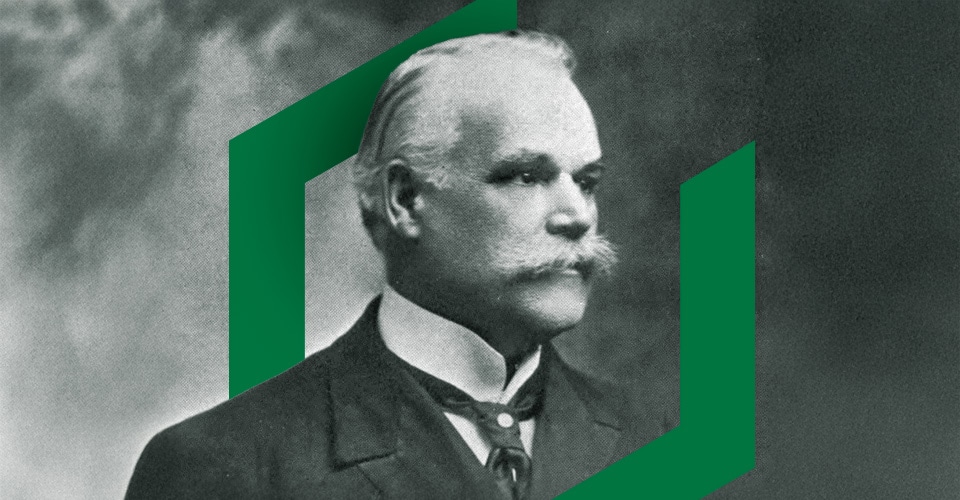
Alphonse Desjardins
Biographical profile of Desjardins Group’s founder.
Childhood
Gabriel-Alphonse Desjardins was born on November 5, 1854, in Lévis, across from Quebec City. He was 8th of 15 children in a family of modest circumstances.
His father, François Roy (nicknamed Desjardins), was a day worker who never managed to hold a job for long. His mother, Clarisse Miville (nicknamed Deschênes), had to work for neighbours as a housekeeper
Alphonse Desjardins attended Collège de Lévis. From 1864 to 1870, he completed the 4-year business course, and 1 year of Latin. His academic records show him to be a resolute, diligent student. He did not let having to repeat the 3rd year of the business course discourage him. Instead, he was one of the top students in his class and won several awards. The same went for the first year of Latin.
In addition to receiving numerous awards, he was selected as a candidate for Académie Saint-Joseph, a society that rewarded the efforts of deserving Collège de Lévis students. Young Desjardins often missed class and became an average, inconsistent student, since family support began to run dry. In July of 1870, at age 15, he was forced to leave school, probably because traditional education was just too expensive.

From worker to entrepreneur
For a quarter of a century, Alphonse Desjardins followed in the footsteps of his older brother Louis-Georges Desjardins (1849-1928), a journalist, military man and Conservative politician.
In the summer of 1869, he enlisted in Lévis’s 17th Battalion, Volunteer Infantry where Louis-Georges held the rank of warrant officer. After attending the Military School of Quebec in 1870, Alphonse Desjardins was promoted to sergeant major. On October 17, 1871, the young non-commissioned officer set out for Red River in Western Canada as part of an expedition against the American Fenians, a revolutionary group fighting for the independence of Ireland. But his military career was short-lived.
Back in Lévis, he became a member of the conservative press. In 1872, he began working at L’Écho de Lévis where he learned the basics of journalism. The following year, the paper sent him to Ottawa as correspondent. There, he sought out new experiences, in both playwriting and mutuality as it applies to homebuilding. But his ideas remained in the planning stage.
When L’Écho de Lévis ceased publication on July 12, 1876, Alphonse Desjardins went to work for Le Canadien, a Quebec City daily of which his brother Louis-Georges had recently become co-owner. He made many contributions to the paper. In addition to short news items, he occasionally reviewed the British press’s coverage of all aspects of daily news and wrote a column on local Lévis news. In practice, the young journalist’s primary task was soon determined by current events. In 1877 and 1878, Le Canadien’s editorial team assigned him to cover the debates in the Quebec Legislative Assembly. There, he demonstrated on-the-job skills that won him the esteem of his colleagues in the press gallery. On June 19, 1879, they made him a member of the executive committee of Association des journalistes de la province de Québec.


Social commitment
Alphonse Desjardins’s work as a reporter opened doors for him in Quebec City society. On December 15, 1877, he was one of the founding members of Société de géographie de Québec. He was also active in the Conservative Party.
In 1878 and 1879 he was on the management committee of Club Cartier de Québec, a Conservative political club. As a result, he acted as secretary of Comité central conservateur du comté de Lévis in the federal elections in fall 1878.
His political commitment earned him the position of editor of the proceedings of the Quebec Legislative Assembly from 1879 to 1889. His job consisted in summarizing the members’ speeches and reporting their main points in Débats de la Législature de la Province de Québec, an annual publication subsidized by the government.
Ready to start a family, Alphonse Desjardins married Marie Clara Dorimène Roy-Desjardins (1858-1932) in Sorel on September 2, 1879. The couple had 10 children, 6 boys and 4 girls.
In the 1880s and until the mid-1890s, Alphonse Desjardins was active in various associative networks in Lévis society. He became deeply involved in Lévis cultural organizations devoted to literary and patriotic topics such as Institut canadien-français, of which he was president in 1883, and Société Saint-Jean-Baptiste. He was also involved with charitable and philanthropic organizations such as Société Saint-Vincent-de-Paul and Congrégation des Hommes de Notre-Dame de Lévis. In so doing, he joined several networks, which he would put to good use when the time came.
During the same period, his work with Chambre de commerce de Lévis gave him an opportunity to take part in a series of initiatives aimed at local city development. He was aware of the debate regarding the lack of a lending institution in Lévis. Following the footsteps of his brother Louis-Georges once again, he was on the board of Chambre de commerce de Lévis, first as secretary-treasurer from 1880 to 1888, and then as advisor until 1893.


A shift in political climate
Alphonse Desjardins continued to quietly edit the parliamentary debates. But in 1887 the situation changed when the Liberals, headed by Honoré Mercier (1840-1894), took power.
Immediately, the Liberals considered taking the parliamentary debates away from Alphonse Desjardins to give them to another editor. He overcame these difficulties, but only for a time. On December 14, 1889, he learned that the Mercier government would no longer underwrite the publication of debates to reduce public expenditures. A partisan motive lay behind these budgetary considerations. It is said that Alphonse Desjardins’s refusal to make substantive changes to his report of a debate on funding for the inter-provincial conference of 1887, at the request of Honoré Mercier or one of his close collaborators, was the reason publication was halted. The “Desjardins debates” were published for the last time in winter 1890.
Overnight, Alphonse Desjardins found himself unemployed. Forced to make a career shift, he decided to return to journalism. On July 9, 1891, in Lévis, he launched a new daily, L'Union canadienne, in which he supported the program of the federal Conservative party. A true generalist, he was both owner and publisher. But health problems forced him to cease publication of the paper on October 10, 1891, after only 3 months.
For the last time, Alphonse Desjardins used partisan politics to make a career shift. From 1890 to 1893, he was secretary of the Provincial Conservative Association in Lévis. In the winter of 1891, he worked for the Conservative party for the federal election. The Conservative government in Ottawa sought a way to reward the long-term activist. On April 22, 1892, the federal Parliament adopted a report from the debate committee recommending the appointment of Alphonse Desjardins to the position of French stenographer at the Ottawa House of Commons. He would hold the position until he retired in 1917. Eager to keep his home in Lévis, he resigned himself to spending 6 months a year in Ottawa, 450 kilometres away from his family, for 25 years. This new life helped him regain his interest in insurance and mutuality.
In 1893, he compiled notes for a study of life insurance in Notes pour servir à une étude sur l'assurance-vie. He also carefully studied the workings and activities of existing mutual aid societies in Lévis, in particular the local branch of Société des Artisans canadiens-français, opened in 1889, and Société de construction permanente de Lévis, founded 20 years earlier. From 1892 to 1895, he served on the board of the latter, which provided mortgages to its members. A tireless individual, he still found a way to teach stenography at Collège de Lévis from 1893 to 1900 in between parliamentary sessions in Ottawa.

A defining moment: the debate on usury
In 1897, Desjardins heard, in the House of Commons in Ottawa, a debate that made him aware of the devastating effects of usury.
The following year, he came across a work entitled People’s Banks by British author Henry William Wolff (1840-1931), president of the International Co-operative Alliance. He immediately contacted the author and a long correspondence between the 2 men began. Wolff agreed to introduce Alphonse Desjardins to various European cooperators.
Little by little, Alphonse Desjardins launched into a serious investigation of cooperation on an international scale. His main considerations were the social issues in Quebec. He saw the social devastation caused by industrialization, rural exodus, unemployment and emigration to the United States. The scourge of usury was only one of many telling example of the social problems. He criticized the government’s inability to bring about effective reform, while neither the labour movement nor socialism could propose viable alternatives. Association and local development were at the heart of Desjardins’s thinking, as well as the influence of Church social doctrine and the social economy in the same line of thought as the encyclical letter Rerum Novarum (On the Condition of Workers) by Pope Leo XIII (1810-1903).
The caisse populaire model
The caisse populaire concept is modeled after European savings and credit systems, such as credit unions, the Schulze People's Bank, the Raiffesisen Rural Lending Bank and the Luzzatti People's Bank. He then took into account the North American environment and experience and defined a new type of institution adapted to the Quebec and Canadian context.
The readiness with which Alphonse Desjardins adopted the cooperative model can in large part be explained by the fact that he saw several points of convergence between the European cooperative experience and his own, acquired in Lévis’s associative networks. In his European counterparts, he found values and organizational principles he had already experienced in various Lévis institutions. This is why he was easily able to make modifications to the European models and propose a new, original one.
After his long, fruitful research between 1898 and 1900, Alphonse Desjardins concluded that the solution to social issues lay in a cooperative association. His caisse populaire model, whose operations were limited to the parish, was the first step in his cooperative project organization plan. His goal was not only to fight against the problem of usury; he also want to empower the working classes, give them the means to manage their own capital without interference from the state, develop the habit and desire to save, and finally, make credit more widely available.

A modest start
On December 6, 1900, Alphonse Desjardins saw the crowning of all his efforts. Over 130 citizens were present at the founding of Caisse populaire de Lévis, the first savings and credit cooperative in North America, which launched its activities in January 1901. At the end of the first day, the amount collected came to only $26.40. A very modest start.
The first few years, most transactions were made either in the Desjardins family home, which housed the Caisse head office, or in the hall of the Lévis branch of Société des Artisans canadiens-français. Over the next 5 years, only 3 other caisses were founded: Saint-Joseph de Lévis in 1902, Hull in 1903 and Saint-Malo à Québec in 1905.
In the meantime, Caisse populaire de Lévis made fast progress thanks to the work and selfless devotion of Alphonse Desjardins, the support of the Lévis clergy, in particular the priests at Collège de Lévis, the quiet and effective work of local mutualists and the ongoing, willing collaboration of his wife, Dorimène Desjardins. In addition to keeping up the family home, Dorimène Desjardins oversaw Caisse business affairs. Between 1903 and 1906, she managed the Caisse, without title or salary, during her husband’s extended stays in Ottawa.

A legal issue
For more than 5 years, Desjardins made several repeated attempts to set up a legal framework for his caisse populaire project with both the provincial and federal governments. Early on, his preference was for the adoption of a federal law that would allow him to establish caisses populaires in all Canadian provinces. Shortly after Caisse populaire de Lévis was founded, he first approached the federal government, who lent a deaf ear.
To achieve their goal, Alphonse Desjardins and his associates would have to put serious pressure on the federal government. Desjardins engaged in an intense propaganda campaign aimed at the public authorities. At first, he sought international recognition. In 1904, he became a member of the International Co-operative Alliance, which granted him the privilege of having membership as an individual. He would remain a member until 1910. But Alphonse Desjardins’s efforts were mostly focused within the country. In 1904, for example, he founded L’Action populaire économique, an association devoted to expanding the realm of people’s economic organizations and lobbying governments to pass legislation recognizing caisses populaires. But nothing would do and Ottawa refused to budge. Reluctantly, Desjardins turned to the Quebec government in 1905.
That year, Desjardins’s initial attempts led to further delays. Exhausted by the wait, Alphonse and Dorimène were also more than a bit disappointed since their family was highly vulnerable to the risk associated with the legislative gap surrounding the caisses populaires. In the spring of 1905, on the verge of despair, the couple considered abandoning their project. Members of the Lévis clergy, particularly Msgr. Bégin (1840-1925), Archbishop of Quebec, encouraged them to persevere.
Things started moving in 1906. On March 5, the Quebec Legislative Assembly unanimously passed the Quebec Syndicates’ Act, which received royal assent 4 days later. Upon hearing the long-awaited news, Alphonse Desjardins rejoiced. The caisses populaires had finally received legal recognition.
Alphonse Desjardins did not abandon his goal of having a law passed by the federal government. He continued to believe that the provincial law’s scope was too regional and only provided a provisional guarantee. He made yet another attempt with the help of Jacques-Cartier Conservative MP Frederick Debartzsch Monk (1856-1914), at the time in parliamentary opposition, who, on April 23, 1906, introduced to the House of Commons the Act respecting industrial and co-operative societies.
This time he met with success. Between December 18, 1906, and April 11, 1907, the House of Commons Special Committee in charge of studying the project heard several testimonies, including very favourable comments from Governor General of Canada and Honorary President of the International Co-operative Alliance, Lord Earl Grey (1851-1917). The committee recommended the government pass the measure. Less than a year later, on March 6, 1908, the House of Commons unanimously adopted the bill regarding cooperation.
The Senate, however, defeated the bill by a single vote on July 15 of the same year, on the grounds that it would infringe on the powers of the provinces. The result, no doubt, of a nationwide opposition campaign led by the Retail Merchants’ Association of Canada, whose primary function was to prevent the development of consumer cooperatives. This new setback marked the end of Desjardins’s efforts on the federal level. Until 1914, a few MPs would try to get legislation on cooperation passed, but to no avail. Faced with the federal government’s inertia, Alphonse Desjardins would have to make the most of the provincial law, even if its scope seemed limited.

Promotion and development
In Quebec, however, the legal recognition of caisses populaires had the effect of opening the floodgates. The years from 1907 to 1915 were the most active of Alphonse Desjardins’s entire lifetime. During this time, he criss-crossed Quebec to help found and develop caisses populaires.
His most devoted associate is Abbé Philibert Grondin (1879-1950), a priest at Collège de Lévis, who conducted a publicity campaign in the Catholic press.
Between 1909 and 1920, he wrote at least 300 newspaper articles, mostly devoted to caisses populaires, in La Vérité and occasionally in L’Action sociale (which would become L’Action catholique in 1915), 2 mass-circulation papers in Quebec City. In 1910, he also published Catéchisme des caisses populaires, a booklet that through questions and answers presented all necessary information about the goals, organization, and functioning of caisses populaires.
For his part, Alphonse Desjardins spent his time personally and promptly answering the many requests for information he received every day. He was also available for public lectures, speeches and talks. He produced a large body of work including pamphlets and newspaper and magazine articles on the topic of cooperation in general terms, and savings and credit cooperatives in specific terms.
As the founder, Alphonse Desjardins orchestrated, with the help of a handful of close collaborators, the budding caisses populaires movement. His involvement was such that he, in some ways, played the role of a federation. His publicity campaign promoting the caisses grew considerably. In 1908 alone, he travelled approximately 5,380 kilometres throughout Quebec to accept a variety of invitations. He gave 52 public lectures and over 150 talks. He also received 2,500 letters, often requiring detailed answers.


Social network
In his work promoting caisses populaires, Alphonse Desjardins was carried by a social dynamic that allowed him to build a considerable social network.
Despite initial reservations on the part of a few members of the high clergy, several bishops, particularly Msrg. Bégin of Quebec, actively supported Desjardins’s work. He preferred to receive explicit support from local priests before establishing a caisse populaire in their parish. He also invited the priests to take on the administration, even the management of the caisse. In several parishes, parish priests were the real organizers of caisses populaires.
Overall, the clergy responded favourably to the call launched by Alphonse Desjardins, but support was not unanimous. Convinced of the benefit the caisses populaires could bring to their faithful, several bishops recognized the caisses populaires as a Catholic social undertaking, which they recommended to their clergy’s attention. Desjardins’s reputation spread all the way to the Vatican. On April 12, 1913, a representative of Msgr. Bégin, Archbishop of Quebec, delivered to Alphonse Desjardins papal letters from Pius X (1835-1914), naming him Commander of the Order of St. Gregory the Great to reward him for his civil merit and contribution to Catholic social action.
Desjardins also used informal networks within the parish community as a foothold. Women were called upon to play a key role in his cooperative project. On a higher level, he could count on, crucial at the time, the support of organizations attached to the Catholic Church in Quebec: Action sociale catholique, Association catholique de la jeunesse canadienne-française, Ligues du Sacré-Cœur, École sociale populaire, social action diocesan committees, as well as agricultural and land settlement cooperatives.
The clergy gave him direct and enthusiastic support, with a steadiness and efficiency dependent, however, on its priorities, as well as cyclical ups and downs. The clergy apart, Desjardins recruited the most ardent promoters of the caisses among nationalists such as Henri Bourassa (1868-1952) and his associate Omer Héroux (1876-1963) of newspaper Le Devoir, established in 1910. In comparison, he received only circumstantial support from unions and fraternal benefit societies. Over the years, Alphonse Desjardins’s cooperative project gained recognition through the Catholic press, of course, but also by word of mouth, from one parish to another, finally expanding to all 4 corners of the province.
All this support was helpful to the caisses populaires, since Desjardins faced serious opposition, from the Canadian Merchant’s Association and the National Bank, who viewed the caisses as competitors.

The caisses populaires grow
Building on this social network, the caisses populaires soon became widely known. As of 1909, Alphonse Desjardins was overwhelmed with invitations from people who wanted to set up a caisse in their own parish. From 1907 to 1915, he founded at least 136 caisses in Quebec alone.
He also corresponded regularly with many caisse managers, providing advice and encouragement, which allowed him to supervise their operations from a distance.
Alphonse Desjardins accomplished all this in his free time in between parliamentary sessions in Ottawa, with no financial assistance whatsoever. He often thought up various scenarios that would allow him to get a government grant to help finance supervision and guidance services, for which he would be responsible. But the fear of interference from the state in caisse internal affairs prevented him from making any such request.
Alphonse Desjardins’s reputation and renown grew to the point that he received invitations and requests for information from several Canadian provinces, but Ontario was the only province to which he personally extended his activities. After helping establish a sector caisse in 1908 for federal civil servants in Ottawa, he founded 18 caisses populaires in French-Canadian parishes between 1910 and 1913. His influence also extended to English Canada on a more intellectual level, since, because of his experience, he was regarded as a specialist in his field. His most voluminous correspondence was with George Keen (1869-1953), General Secretary and Treasurer of the Co-operative Union of Canada, founded in 1909.
The same went for the United States. Alphonse Desjardins visited the U.S. 5 times between 1908 and 1912. In addition to founding a dozen caisses populaires and credit unions, mostly in Franco-American parishes, he had a profound influence on cooperative legislation in several states. In Massachusetts, New York, New Hampshire and North Carolina, bills that led to the creation of credit unions drew liberally from the caisses populaires model and Quebec legislation.
As of 1914, Alphonse Desjardins was forced to cut back on his activities due to illness. Incurable uremia sent him into lengthy and frequent periods of convalescence between brief bouts of remission. In 1917, he had to give up his duties as House of Commons stenographer after 25 years of service. The threat of impending death made him consider creating a federation and central caisse to unite and strengthen the caisses populaires network and ensure his work endured. He had developed an action plan in that regard at least 10 years earlier.
Based on the European cooperative experience, he wanted to bring local caisses populaires together within a provincial federation that would be responsible for publicity, supervision and verification. In addition, a central caisse would administer local surplus funds held by local caisses and provide loans to those short on funds. Afraid of losing their autonomy, caisse officers did not take well to the idea, especially because of serious issues surrounding the federation’s financing and the division of power. Aware of the issues, Alphonse Desjardins proposed, on July 3, 1920, a preliminary meeting of all caisse representatives to study the proposal. But his days were numbered.


Death
On October 31, 1920, Alphonse Desjardins died in his home in Lévis, a few days shy of his 66th birthday. He was buried on November 4, 1920, following a stately funeral attended by several representatives of the Church and both governments.
There were at that time some 140 caisses active in Quebec, with total assets of $6.3 million and 31,000 members.
Alphonse Desjardins left behind an instrument of cooperation and local development designed to meet the needs and aspirations of parish communities. When paying posthumous tribute to the founder of caisses populaires, several newspapers heralded the economic and social scope of his work. After designating Alphonse Desjardins as “one of the great benefactors of his kind,” Quebec City’s L’Action catholique predicted that the caisses would become “the solid base of the French-Canadian national fortune.” Similarly, Le Devoir stated that his name would remain “one of the founders and pioneers of the cooperative movement in Canada.”
