- Nom du rédacteur
- Francis Généreux
Principal Economist
Economic News
United States: As Expected, Energy Prices Push Inflation Sharply Higher
April 10, 2026
Highlights
- The Consumer Price Index (CPI) rose by 0.9% in March, following a 0.3% increase in February. Core CPI, which excludes food and energy, increased by 0.2%.
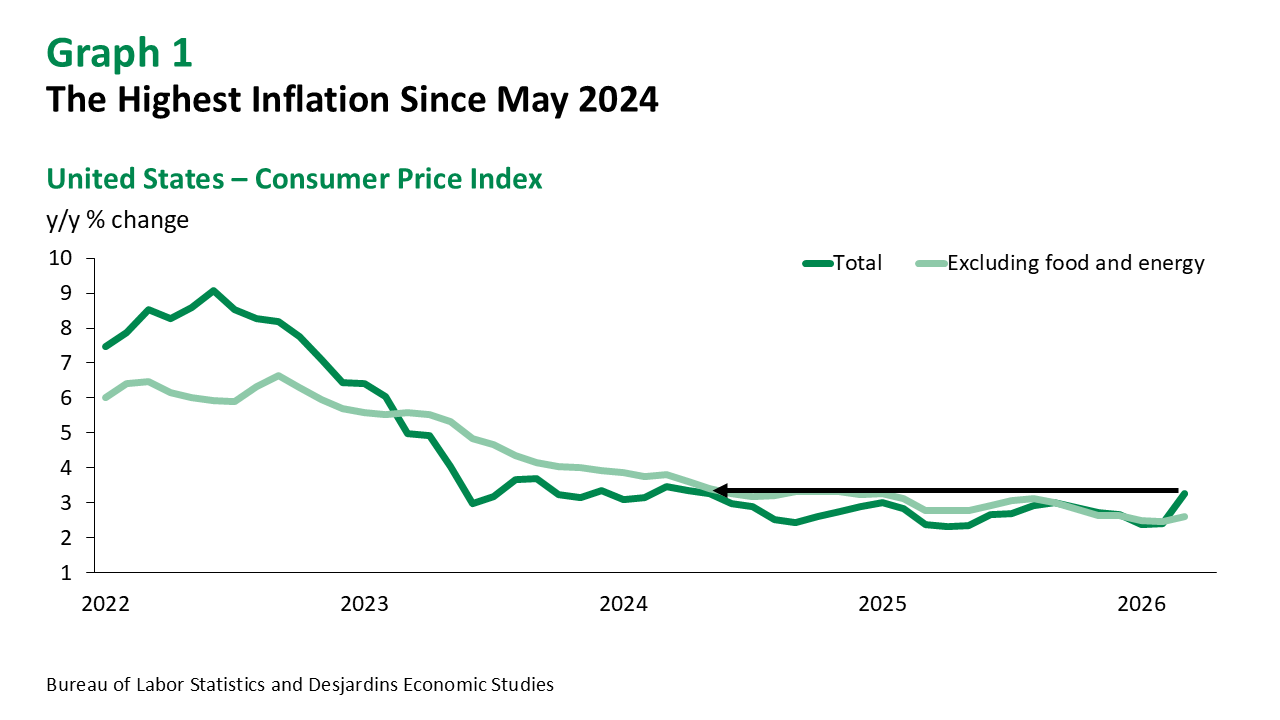
- On a year-over-year basis, headline CPI climbed from 2.4% in February to 3.3% in March. Core inflation edged up more modestly, from 2.5% to 2.6%.
Comments
The outcome was widely anticipated, but the magnitude of the shock was nonetheless significant. In March, headline CPI posted its largest monthly increase since June 2022. This surge was primarily driven by higher energy prices stemming from the conflict in Iran and the Persian Gulf. Energy prices rose by 10.9% during the month, reflecting a 30.7% increase in fuel oil prices and a 21.2% rise in gasoline prices. Higher prices at the pump accounted for nearly three quarters of the monthly increase in headline CPI. By contrast, prices for energy services (natural gas and electricity) increased much more modestly (+0.4%), while food prices were essentially flat in March.
Once again, consumer price growth excluding food and energy was more subdued than expected, with a third gain of 0.2% in four months. Price increases for goods excluding food and energy were restrained in part by declines in used vehicle prices, household appliances and medical goods. That said, notable increases were still observed for clothing and information technology equipment. It remains to be seen whether the easing of certain tariffs following the Supreme Court ruling will eventually affect imported goods prices. However, given that the upward impact of tariffs was fairly limited, the downward effect is also likely to be modest.
On the services side excluding energy, some easing was observed, despite slightly stronger monthly increases for shelter and transportation services. Nonetheless, the year-over-year increase in services prices excluding energy and shelter exceeded 3% for the first time since last September.
Implications
Going forward, close attention will need to be paid to developments in energy prices. Gasoline prices have continued to rise in recent days. As a result, prices so far in April are nearly 15% higher than the March average. Headline inflation is therefore likely to accelerate again, potentially surpassing 3.5%. Beyond that, the spillover effects of higher energy prices on other goods prices—particularly food—as well as on inflation expectations among households and businesses will warrant careful monitoring. If oil prices remain very elevated for an extended period despite the fragile truce, inflationary pressures could broaden and economic conditions could deteriorate. That said, the recent resilience of the US economy suggests that this remains a downside risk scenario rather than the base case.