- Nom du rédacteur
- Sonny Scarfone
Principal Economist
Economic News
Quebec: Quarterly GDP
After a Turbulent 2025, 2026 Is Opening in a Still Fragile Environment
March 26, 2026
Highlights
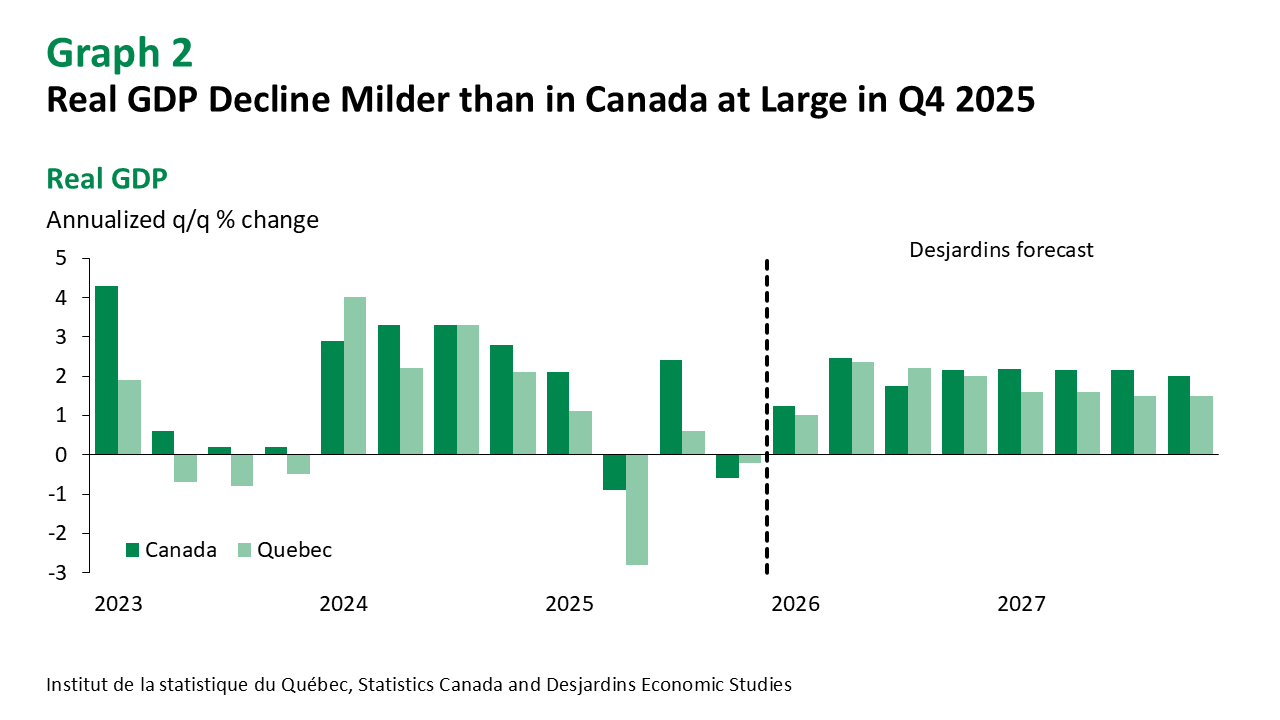
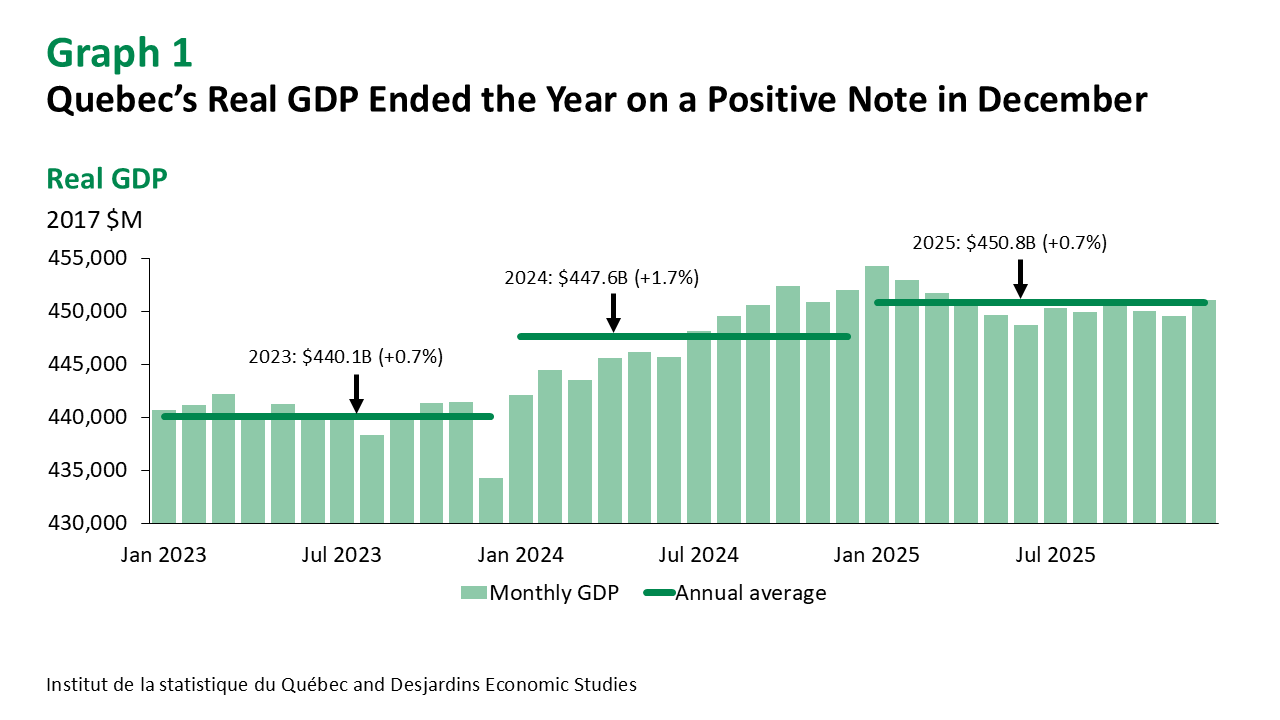
- In Q4 2025, Quebec’s real GDP declined by 0.2% at an annualized rate, a contraction that was less pronounced than in Canada External link. (-0.6%). For the full year, Quebec’s real GDP grew by 0.7%, a pace well below the national result (+1.7%).
- From the perspective of momentum heading into 2026, GDP by industry increased for a rare time since the start of the trade conflict in December (+0.3%) (graph 1). For the year as a whole, goods production fell 1.2%, while services more than offset that decline with a 1.4% increase.
- Domestic demand in Q4 ended up saving the day, posting 2.1% growth and allowing the year as a whole to finish with a positive 1.8% result (table).
- International trade remains the main drag on growth, even though the last quarter showed an increase in exports and a reduction in imports. The sharp drop in Q2 (-15.8% at an annualized rate, including -26.6% for international trade and -35.7% for goods alone) was only partially recovered afterward, with international goods exports posting a 2.7% decline in 2025 compared with the previous year.
- Inventory investment fell sharply in the last quarter ($4.1B), the largest drop since 2020. This development explains the decline in Quebec’s real GDP in Q4 despite the acceleration in domestic demand and the improvement in the trade balance.

Comments
It is now time to take stock of what turned out to be a turbulent 2025, and while the direction of the final numbers is hardly surprising, their magnitude proved somewhat less pronounced than one might have feared at the start of the year.
As for sectoral performance, the weakness came mainly from manufacturing (-3.9%), with the sector specific tariffs imposed by the United States hitting primary metal processing particularly hard (-11%) as well as furniture and related product manufacturing (-8.4%). The fact that Quebec faced higher effective tariff rates than the national average explains much of the gap in real GDP growth in 2025. Residential construction (+2.1%) was one of the few bright spots among goods producing industries.
On the services side, most sectors contributed positively, but professional, scientific, and technical services stood out for their weakness (+0.1%), a particularly slow pace for a non recessionary period. In a context where the future effects of artificial intelligence remain uncertain, this sector will be one to watch.
Household final consumption was particularly strong, especially given that Quebec’s population is estimated to have fallen by about 25,000 people during the same quarter and by 10,000 people for the year as a whole. Durable goods consumption (-2.7% at an annualized rate in the last quarter) was the only category to decline in 2025 (-1.1%), a segment that depends heavily on consumer confidence.
Private investment ended 2025 on a positive note. For the year as a whole, residential buildings showed an acceleration compared with 2024, while the other categories slowed. Machinery and equipment even posted negative growth, reflecting in this case weak business confidence, which also showed up in the low level of hiring during the year.
Public sector investment declined in real terms for a second consecutive year, a result that contrasts with the continued high level of investment under the Quebec Infrastructure Plan.
On the trade balance front, it is worth noting that while interprovincial exports provided some support with a 0.7% increase in 2025, goods exports declined (-2.3%). Imports from other provinces also fell (-1.9% overall, -5.2% for goods). At a time when Canada is seeking to reduce, or even eliminate, internal trade barriers, this weakness in coast-to-coast trade is rather disappointing.
Implications
All in all, 2025 ends with a mixed report card and 2026 is shaping up to be anything but restful. Recent data confirm that conditions remain fragile, even though our latest Economic and Financial Outlook External link. points to a modest pickup in activity in Quebec, with growth expected to reach 1.0% in 2026 (graph 2). The review of the Canada‑United States‑Mexico Agreement (CUSMA) as well as the duration and scope of the conflict in the Middle East remain the main risks to watch in the coming months.