
- Nom du rédacteur
- Sonny Scarfone
Principal Economist
Weekly Commentary
Quebec’s Financial Situation: Short-Term Improvements, Long-Term Constraints
June 19, 2026
The preliminary results for the 2025–2026 fiscal year point to a marked improvement in Quebec’s financial situation. The accounting deficit is now reported to be $4.9B, which is $2.8B less than projected in the 2026–2027 budget released in March (graph 1). This positive development stems partly from revenues that were slightly higher than anticipated, but the biggest boost came from lower-than-expected spending, in part because some planned outlays were not yet realized.

At first glance, these results suggest that the province is holding strong. But on closer inspection, some caution may be warranted, especially since Quebec’s fundamentals are still fragile, as mentioned in our most recent Economic and Financial Outlook External link..
Many Improvements Can Be Attributed to One-Off Factors
A non-negligible portion of this improvement appears to be related to circumstances that will not be replicated. On the revenue front, gains in some areas were supported by macroeconomic base effects and unusually favourable conditions, including strong gold and other commodity prices. From a mathematical standpoint, even if these conditions persist, they will no longer contribute to revenue growth. And should they return to more traditional levels, revenues could pull back.
The difference in spending comes largely from expenditures being postponed, not from structural savings. Infrastructure projects, for example, are being completed at a slower pace than anticipated. Portfolio expenditures were also smaller than expected, particularly for some tax credits and financial assistance programs, while other allowances and budgets were only partly used. Taken as a whole, these elements contribute substantially to the difference between earlier projections and preliminary results. (See the Quarterly report External link..)
In other words, a sizeable portion of these fiscal improvements could fade away in the years ahead if planned expenditures are ultimately incurred and economic conditions return to normal. And many of the savings observed so far come from priority portfolios, including Municipal Affairs and Housing, as well as Economy, Innovation and Energy. These amounts will most likely be spent down the road as needs require.
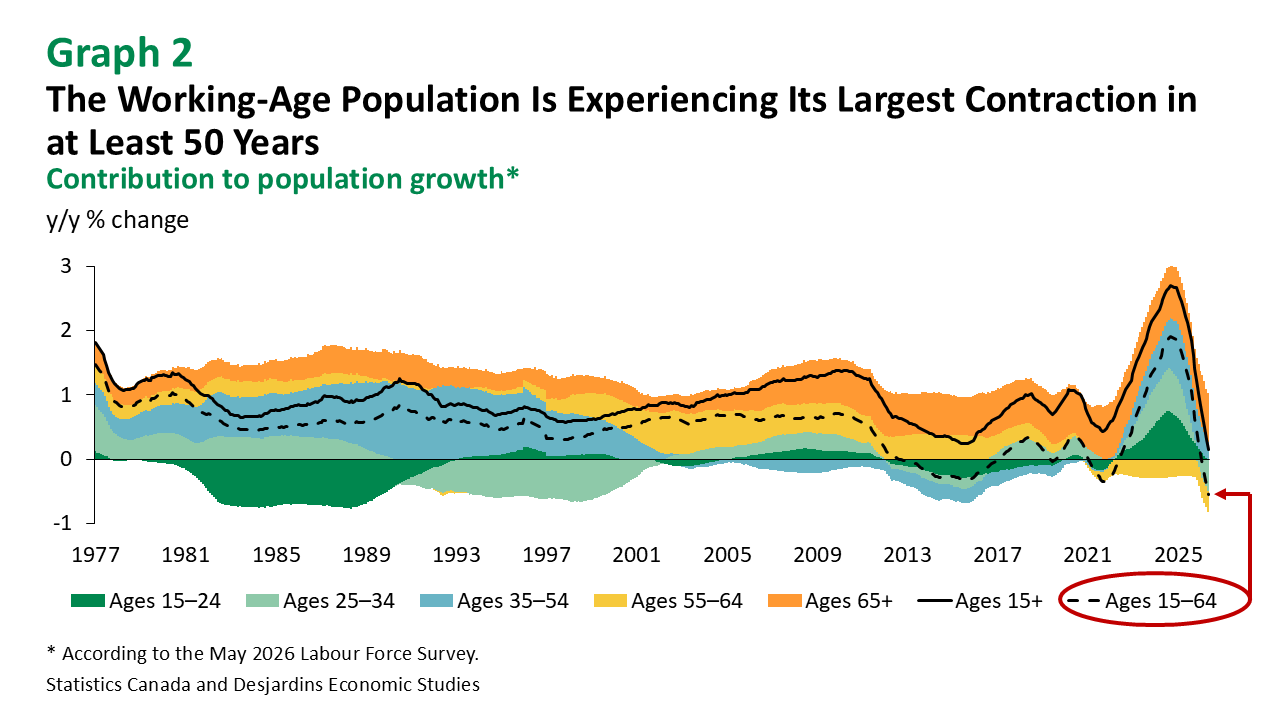
This is an important observation given the headwinds facing Quebec’s economy. As our forecasts highlight, growth remains limited, the goods-producing sectors continue to struggle and exports are still under pressure. On top of that, demographic changes will limit the province’s growth potential. The most recent data from Statistics Canada show that Quebec’s population decreased by 25,000 people between April 2025 and April 2026. According to the Labour Force Survey, the working-age population is shrinking at an unprecedented rate (graph 2).
It’s also worth noting that Quebec’s financial framework was based on fairly cautious assumptions about trade tensions with the United States, including relatively high effective tariff rates. But in reality, tariffs were nearly half their anticipated level for a good portion of the fiscal year, which helped keep revenues up. These cautious assumptions are justified given the circumstances and represent a sound budget practice.
However, Quebec has been hit hard by subsequent tariff hikes, including higher tariffs on metal products in April. As a result, the average effective rate on Quebec’s exports is now close to the 10% originally projected by the Minister of Finance when the budget was tabled in March 2025 (graph 3).

So while these favourable conditions have given the economy a one-time boost, we won’t necessarily see a repeat performance. Looking forward, much will depend on the upcoming CUSMA review and on US policy choices regarding sector-specific tariffs. In short, while Quebec’s financial situation at the moment comes as a welcome surprise, it largely reflects the better-than-anticipated economic environment. The province is still facing a number of structural challenges that require attention.
The Gap to Be Bridged Is Still Significant
Putting the 2025–2026 fiscal year behind us, let us shift our focus to the challenges that remain ahead. At this point, the government has not yet fully specified how it will close the deficit and return to a balanced budget by 2030. In fact, according to our analysis External link. of the 2026–2027 budget, only around 20% of the measures needed to bridge that gap have been identified.
Given that Quebec is expected to continue to lag behind the national average External link., the current plan to reach its fiscal targets depends on rather ambitious assumptions. Softer economic growth could weigh on revenues, and pressures on spending—particularly in public services—show little sign of easing.
While the cyclical improvements to the deficit mean that we ended fiscal year 2025–2026 in a stronger position than anticipated, the issues facing our public finances are structural at their core and the gap to be bridged is still quite large. We must also remember that infrastructure projects cannot be postponed indefinitely. Quebec’s high asset maintenance deficit has long been overlooked but now stands at $45B, pointing to a substantial backlog in public infrastructure upkeep (graph 4). Though it does not qualify as debt in accounting terms and no interest is charged, it still represents a real economic obligation. The costs must ultimately be borne, often at a premium. (See our note External link. on the topic.)
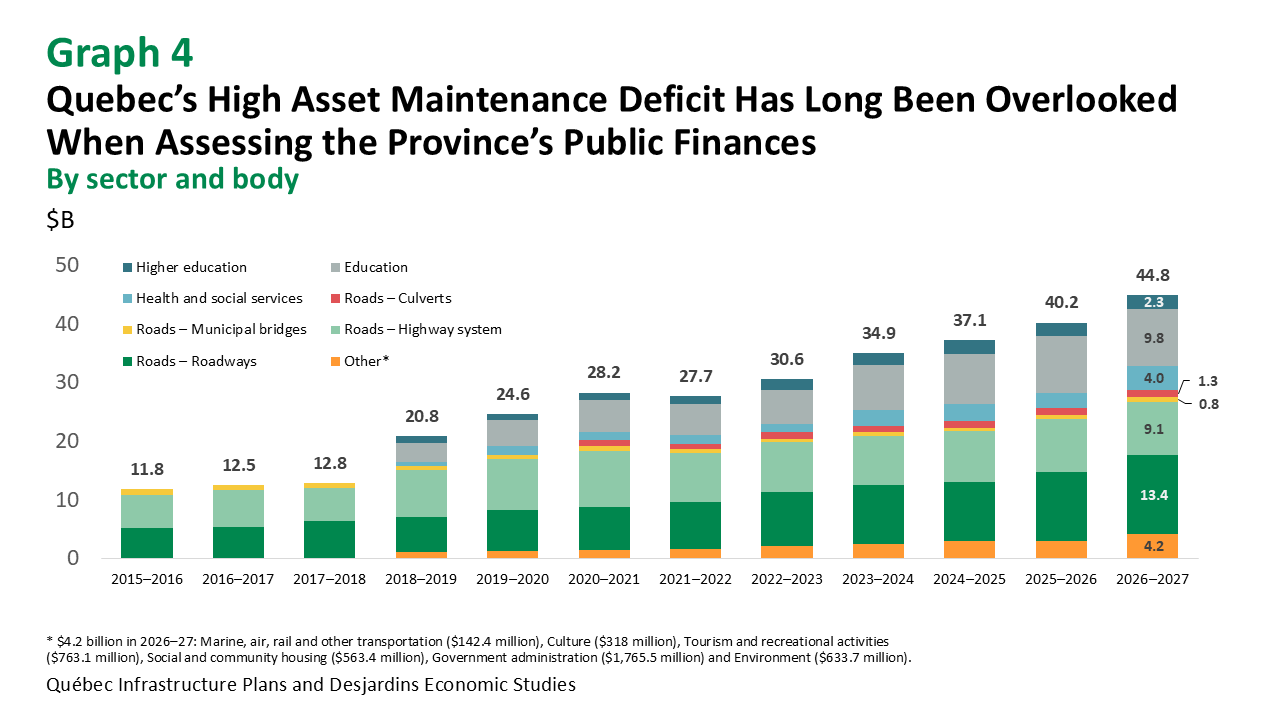
With growth projected to be moderate and fiscal room limited in the short term, this liability will weigh on public finances in the medium and long terms. At some point, service quality and infrastructure will be affected. And when much-needed repairs are eventually made, they’re typically costlier and more complex.
In Summary
The preliminary results confirm that Quebec’s budget has improved appreciably in the short term. However, this is largely due to one-off events at a time when Quebec’s economy is fragile and unlikely to keep up with the rest of Canada, as suggested in our most recent forecasts.
The fundamental challenges remain unchanged: Quebec must still find additional savings or revenue growth, even as its public finances remain subject to economic and budgetary pressures.
The recent results may offer some respite, especially with the elections coming up this fall, but trade-offs will need to be made sooner or later.