
- Nom du rédacteur
- Sonny Scarfone
Principal Economist
Economic News
Quebec: Decline in Real GDP in October
January 27, 2026
Highlights
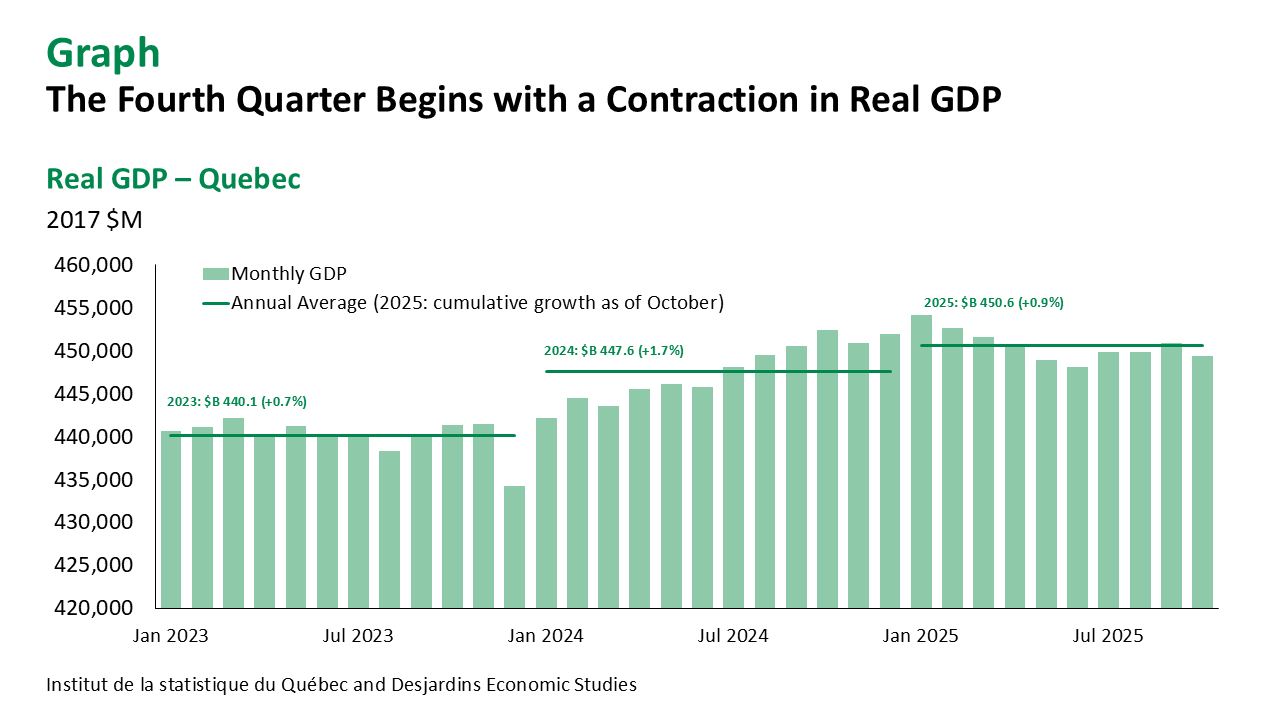
- Real GDP in Quebec fell by 0.4% in October, the first monthly decline since June. This decrease was slightly larger than the drop recorded in Canada where activity fell by 0.3%. Compared to the first 10 months of 2024, Quebec’s GDP still shows a cumulative increase of 0.9% (see table 1).
- The weak print in October reflects softness in both goods producing industries (-0.4%) and services (-0.3%). For goods, beyond the agriculture, forestry, fishing and hunting category, manufacturing was particularly affected and now shows the largest cumulative decline since the start of the year (-3.6%). In services, the beginning of the fourth quarter was also rather weak for wholesale and retail trade.
- Among the sectors that helped limit the decline in real GDP, utilities, accommodation and food services, and the finance and insurance sector all posted gains.

Comments
After a modest return to growth in the third quarter External link., when exports stalled following the sharp decline in the second quarter, Quebec’s economy weakened again in October. GDP by industry shows that sectors tied to international trade such as manufacturing, wholesale trade and transportation and warehousing remain under pressure. Although effective tariff levels External link. remain low due to greater compliance with the Canada-United States-Mexico Agreement (CUSMA), which exempts a large share of duties, Quebec remains more exposed than other provinces because of sector specific tariffs targeting several of its key exports, including aluminum, wood products and the production of trucks and buses.
Implications
Supported by a resilient labour market and major projects underway in both the private and public sectors, a GDP rebound is expected and the fourth quarter should close in positive territory, resulting in overall economic growth of 0.8% in 2025. However, the onset of demographic stagnation External link. will restrain consumption and the continued consolidation of government spending will also weigh on domestic demand. As a result, the outlook will depend largely on a recovery in exports and on the strength of public and private investment. For these reasons, even as the year begins once again in a context of geopolitical uncertainty and ahead of the scheduled CUSMA review on July 1st, our latest forecasts External link. call for a moderate acceleration in economic activity in Quebec in 2026, reaching 1.1 %.