
- Nom du rédacteur
- Laura Gu
Senior Economist
Economic Viewpoint
Canadian Provincial Budget 2026 Roundup
The Easy Gains Are Over
April 16, 2026
Highlights
- Despite a better-than-anticipated macro backdrop as compared to a year ago, Canadian provinces experienced varying degrees of deterioration in their bottom lines. Collectively, the nine provinces that have released budgets are projecting a larger combined deficit of $47B in FY2026–2027 (FY2027), following a slightly smaller $40B shortfall in FY2026 (graph 1).
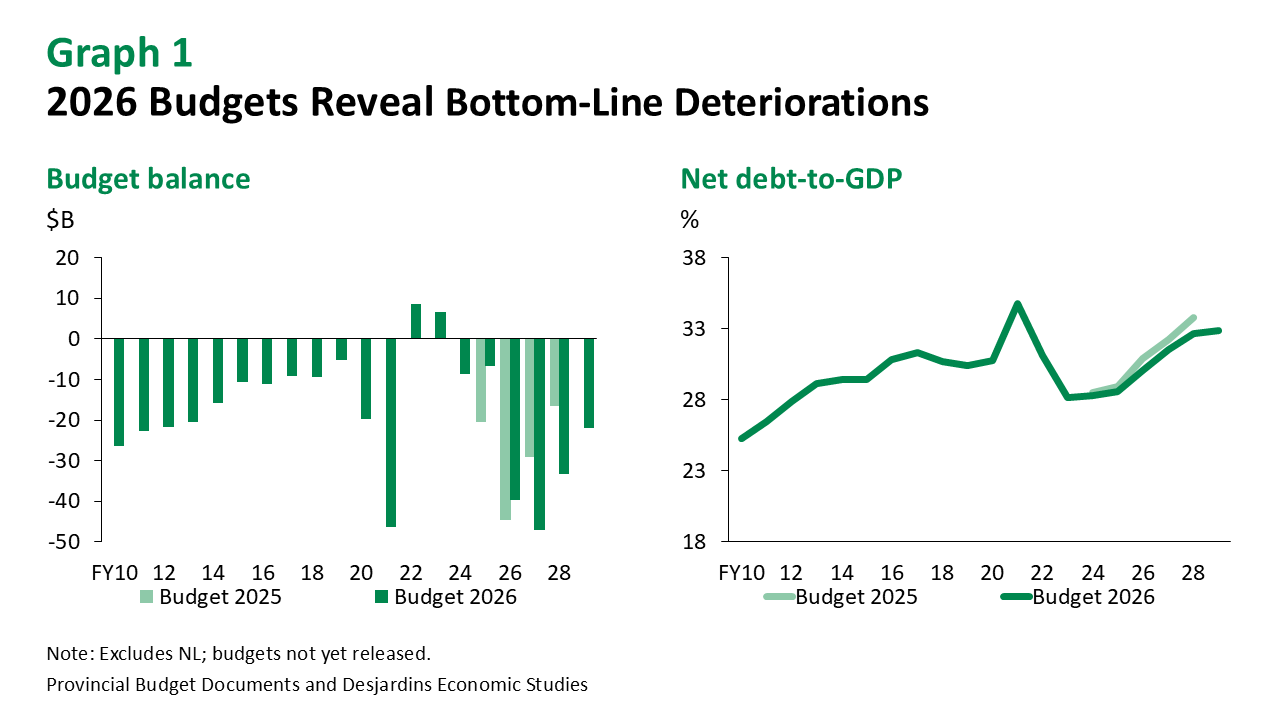
- Upward historical revisions and growth outperformance prompted higher nominal GDP estimates for 2025, boosting provinces’ fiscal starting positions and improving overall debt metrics despite larger deficits and higher debt levels.
- Forecasts continue to point to an economic slowdown in 2026 amid persistent trade risks, with limited revenue upside and material downside risks if the Canada‑United States‑Mexico Agreement (CUSMA) review sours.
- Fiscal positions of energy‑producing provinces are likely stronger than current projections given the geopolitical‑driven oil price surge.
- Higher planned spending accounts for the bulk of the fiscal strain, with spending pressure expected to persist. Provinces collectively added $20B planned spending in FY2027, concentrated in healthcare.
- Past gains in economic momentum provide some near‑term support, and the fiscal picture should prove less bleak as the year progresses, supported by surging oil prices. Beyond that, provinces face more challenging conditions, with weak productivity growth compounded by constrained investment under trade uncertainty, leaving provinces with limited fiscal room at a time when spending pressures remain elevated.