- Nom du rédacteur
- Jimmy Jean, Vice-President, Chief Economist and Strategist • Randall Bartlett, Deputy Chief Economist
Federal budget
Federal Spring Economic Update 2026
Don’t Start Popping the Champagne Yet
April 28, 2026
Highlights
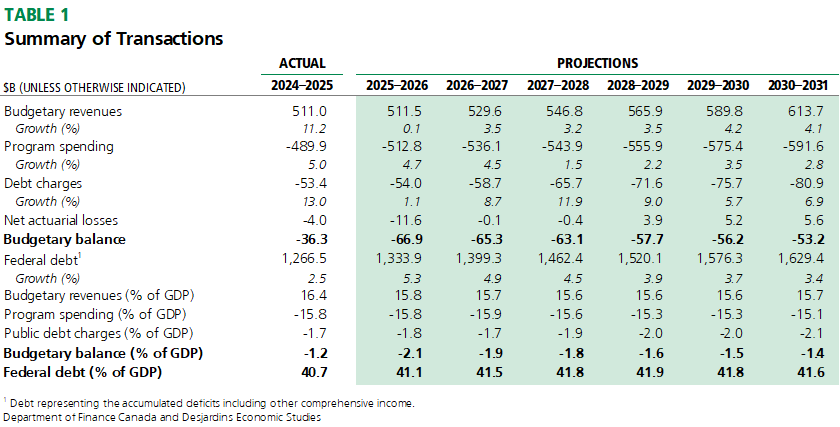
- As was widely telegraphed prior to the Spring Economic Update (SEU) 2026, the federal government’s fiscal performance wasn’t as bad as previously predicted. The 2025–26 fiscal year (FY26) deficit was still a substantial $66.9B, but came in lower than the $78.3B projected in Budget 2025 (graph 1).

- But don’t start popping the champagne yet. A big part of the near-term improvement in the deficit was a better-than-expected economic performance, which is beyond the federal government’s control. It is also something that may not be repeated.
- Despite this improved starting point and economic outlook, the deficit forecast going forward is essentially unchanged from Budget 2025. That’s partly because last year’s savings also stemmed from lapsed spending—money that didn’t get out the door—as opposed to prudent fiscal management. New measures were announced which filled that newfound fiscal room as well.
- On the spending side, many of the big measures were announced well in advance of the SEU 2026. Key measures since Budget 2025 include the Canada Groceries and Essentials Benefit ($11.8B over six years); supporting workers in the skilled trades ($6.0B); $4.1B for empowering and healthy Indigenous communities; $2.0B for supporting Ukraine; $1.7B to work with the provinces and territories to improve the housing supply; additional measures to support workers ($1.3B); increasing student grants and loans ($1.1B); and $1.0B for environmental protection and conservation.
- Turning to revenues, the most substantive of these measures is the temporary suspension of the federal fuel excise tax ($2.4B in FY27). This is followed closely by the revamped tax credit for electric vehicle purchases, at $2.3B over six years. Otherwise, the tax breaks were few and far between.
- One of the major benefits of the upwardly revised nominal GDP outlook is that it reduced the size of future deficits as a share of GDP even if those deficits were largely unchanged from Budget 2025. The projected path for the federal debt-to-GDP ratio is also meaningfully lower, despite the path of the federal debt not changing all that much. This will help to keep Canada in a better fiscal position than many of its advanced economy peers, supporting a strong credit rating and comparatively lower debt services cost.