- Nom du rédacteur
- Jimmy Jean, Vice-President, Chief Economist and Strategist
Randall Bartlett, Deputy Chief Economist • LJ Valencia, Economist
Economic News
Canada: Real GDP Contracted Again in Q1 but It’s Too Early To Call a Recession
May 29, 2026
Highlights
- Real GDP fell at an annualized pace of 0.1% q/q in Q1 2026. This was below the consensus of economic forecasters and the Bank of Canada’s outlook of a 1.5% advance. Table 1 provides more details on the release.
- Monthly real GDP declined in March (-0.1% m/m), coming in below consensus and Statistics Canada’s flash estimate (0.0%). On a quarterly basis, real GDP by industry increased by 0.5% q/q annualized in Q1.
- Statistics Canada expects real GDP by industry to rise in April 2026 (0.4% m/m), citing gains in resource extraction, manufacturing, transportation and warehousing being partially offset by reduced activity in agriculture, forestry, fishing and hunting.

Comments
The decline in real GDP in Q1 2026 was led by a significant drag from net exports (graph 1). This was driven by a sharp rise in imports (12.0%), largely due to increased purchases of gold products. Meanwhile, exports declined modestly (-0.5%), reflecting weaker motor vehicle shipments amid US tariffs. That said, the drag on from trade was more than offset by a bounce in inventories.

Real investment contracted (-4.3%) in Q1, partly attributed to lower government investment (-9.6%) after a defence-driven surge in late 2025. In addition, residential investment contributed to the GDP decline (-7.9%), as resale market conditions remained weak and construction activity slowed. Investment in non-residential structures slipped (-10.2%), but these losses were somewhat offset by higher spending on machinery and equipment (10.2%) and intellectual property products (13.8%).
On the bright side, real household spending rose in the quarter (1.5% q/q annualized) on the back of greater outlays on financial services and food. However, overall domestic demand saw a modest contraction (-0.4%). Despite this weakness, slower population growth contributed to an increase in per capita real GDP in the quarter (graph 2).

Compensation of employees accelerated to 4.8% q/q annualized in Q1. The savings rate decreased to 3.5%—the lowest rate since Q1 2024—as gains in disposable income were offset by higher consumption. Lastly, corporate profits (measured as net operating surplus) grew (9.6%), largely because of gains in the energy sector as the Iran conflict drove up oil prices.
Implications
Given the headline contraction in Q1 real GDP was well below the Bank’s forecast of 1.5%, this reinforces our view that central bank will remain on the sidelines. That doesn’t mean the Canadian economy is out of the woods yet on inflation. Though oil prices have been falling recently, energy prices are high and risk gradually seeping into underlying inflation the longer they remain elevated. Our early tracking also suggests real GDP by should rebound to around the Bank’s forecast of 1.5% during Q2 2026 as shown in the April 2026 Monetary Policy Report External link.. However, the downside risks to inflation remain ever-present, as evidenced by the decline in Q1 domestic demand and weakness in the labour market Indeed, uncertainty around the Canada-United States-Mexico Agreement (CUSMA) joint review could be a major economic headwind, especially if Canada faces an unfavourable outcome.
Are We in Recession?
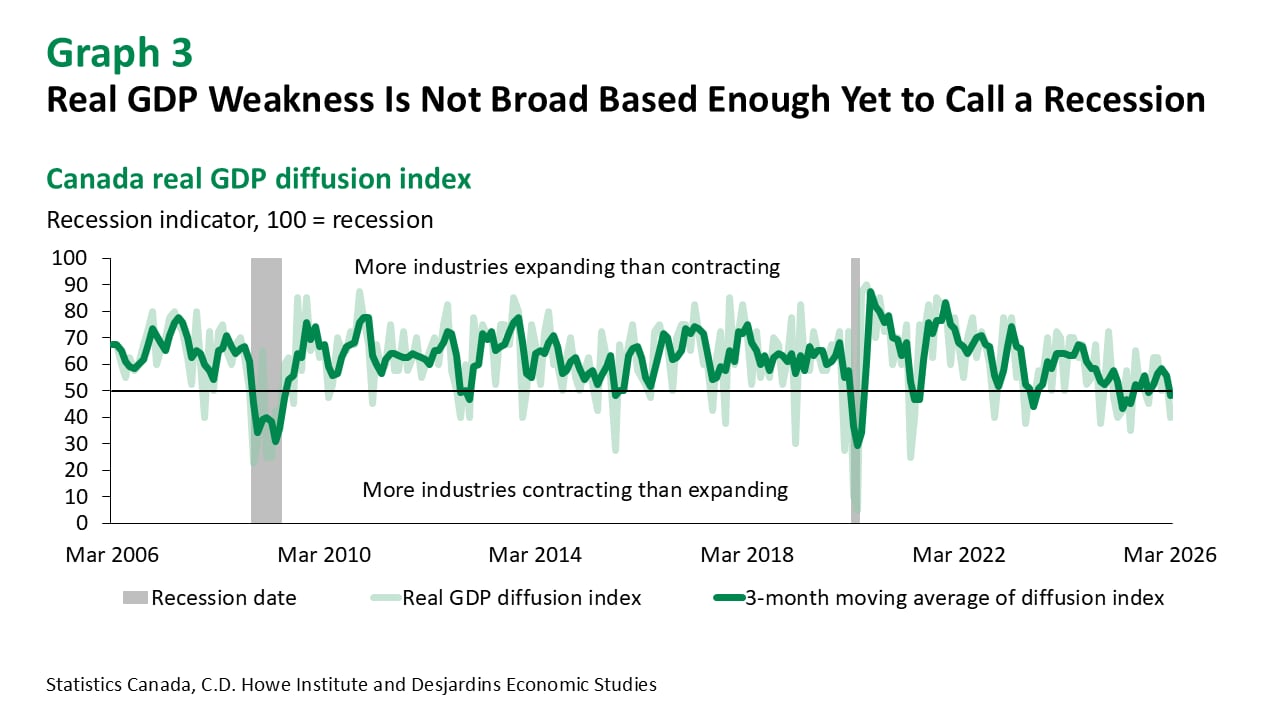
Since the release of the real GDP data this morning, questions have been pouring in regarding whether the Canadian economy is in recession. We don’t believe it is, at least not yet. Yes, real GDP has contracted for two consecutive quarters. But while this is a necessary condition to call a recession, it is not sufficient. That’s because the weakness in the economy needs to be large and broad-based across industries and sectors. And according to our analysis, the Canadian economy is not there yet (graph 3). More than half of the industries in Canada have been expanding over the past six months, and consumers have continued to increase their purchases of good and services. That could change with subsequent data revisions and as new data become available, and we’ll be monitoring that closely.