
- Nom du rédacteur
- Kari Norman
Economist
Economic News
Canada: Unemployment Rate Jumped Despite Job Gains in December
January 9, 2026
Highlights
- Canadian employment increased marginally in December, up by 8k jobs. Economic forecasters anticipated a modest decline. Despite employment impacts from the ongoing trade war with the US, 2025 saw average employment increase by 303k jobs, not far behind the +382k jobs in 2024.
- The unemployment rate rose 0.3 percentage points to 6.8% in the month, finishing 2025 just a tick above where it stood at the end of 2024 (6.7%).
- Total hours worked in December decreased 0.3% month over month, but rose 0.3% year over year. Average hourly wage growth increased 3.4% y/y in December and for 2025 as a whole. Table 1 summarizes key data.
- The December employment data left our 2025 Q4 real GDP growth tracking at around 0.5% q/q annualized.
Comments
Canadian employment moved higher again in December, for a total gain of nearly 190k jobs in four months. December’s advance was driven by healthcare (+20.8k), construction (+11.2k) and education (+10.5k), but largely offset by losses in professional, scientific and technical services (-18.1k) and accommodation and food services (-12.3k). The self-employed accounted for the bulk of December’s net job gain (+7.3k). Strong full-time job growth in December more than outweighed losses from the past two months (graph 1). Over the course of the year, solid gains were made in both part-time and full-time positions.

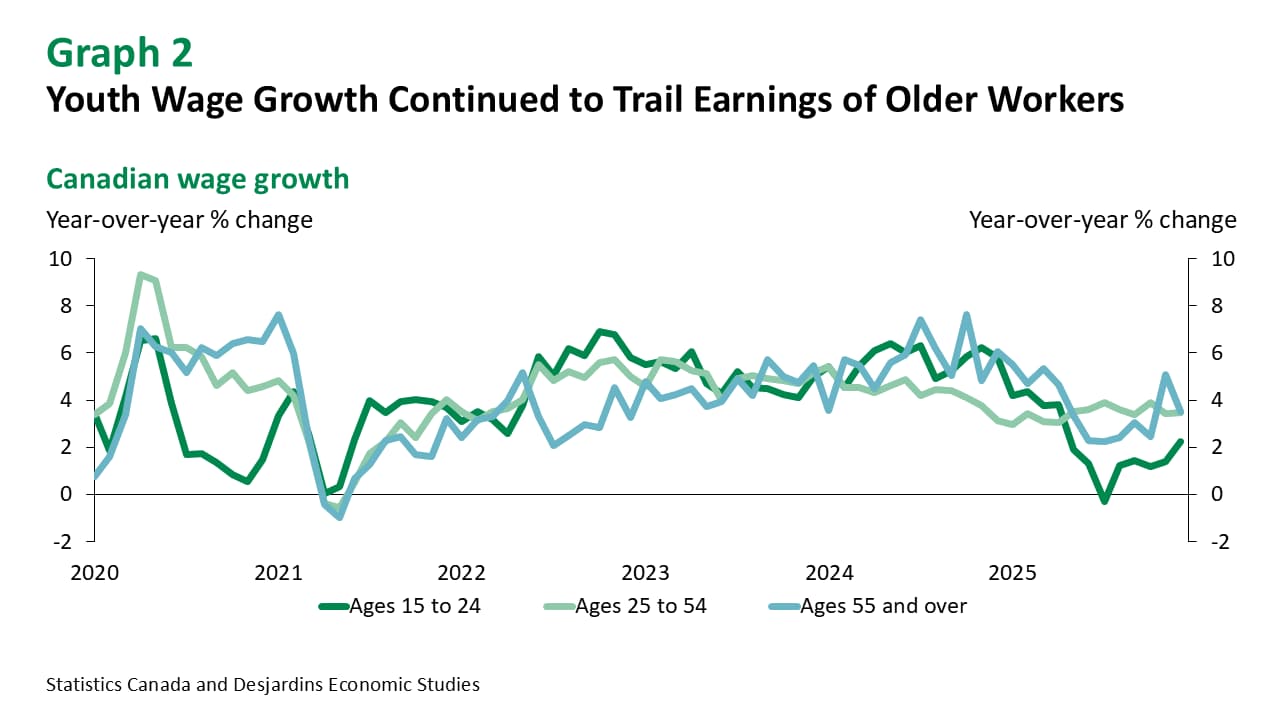
Despite the December employment gain, the 0.3 percentage point increase in the unemployment rate to 6.8% was the headline grabbing story. The unemployment rate for core-aged workers (ages 25 to 54 years) rose 0.4 percentage points to 6.0% in the month as more people searched for work—a silver lining in an otherwise surprising move higher. In contrast, job losses in the youth cohort (ages 15 to 24 years) caused their unemployment rate to rise 0.5 percentage points in December to end the year at 13.3%, albeit remaining below the high of 14.6% in July. December’s average hourly wage rate for young workers increased 2.3% y/y, ending 2025 at just over $22 per hour, well below the average hourly wage growth of 3.5% y/y for core-aged workers (graph 2). That said, by our estimate, wage gains of both groups likely outpaced inflation in 2025.
Regional disparities remain pronounced. Quebec once again had one of the lowest unemployment rates across provinces at 5.6% in 2025, bested only by Saskatchewan at 5.2% (graph 3). Employment growth was particularly strong in Alberta and Saskatchewan, at 2.8% and 2.5% respectively.

Implications
Despite the relatively soft labour market data in December, we expect the Bank of Canada to keep policy rates on hold at its January meeting and for the foreseeable future. Governing Council has indicated that they see the current policy rate as appropriate to keep inflation close to 2% while supporting the economy through the ongoing trade disruption.
