
- Nom du rédacteur
- Randall Bartlett
Deputy Chief Economist
Economic News
Canada: Inflation Accelerated in April but Not Nearly as Much as Expected
May 19, 2026
Highlights
- Headline CPI rose 2.8% y/y in April, accelerating from the March pace (2.4%) but coming in below the consensus expectation of economists (3.1%). Prices were up 0.4% month over month, and rose 0.3% after adjusting for seasonal effects. Table 1 summarizes the key data points.

Comments
It came as no surprise that higher energy prices drove the advance in headline CPI inflation in April (graph 1). Energy prices were up 19.2% y/y in the month, led by a 28.6% spike in gasoline prices. Costs of fuel oil and other fuels increased 41.3% from a year earlier. The oil price impact of the conflict with Iran External link. was the clear culprit. The acceleration in energy inflation was compounded by the impact of the March 2025 consumer carbon tax removal falling out of the year-over-year calculations. These gains were mildly offset by the temporary suspension of the federal fuel excise tax that went into effect on April 20.

While surging energy prices grabbed the headlines in April, inflation of other goods and services continued to slow (graph 2). Non-energy CPI inflation was up 1.8% y/y over April of last year. After removing the cost of energy, shelter inflation also cooled further in April. Rented accommodation CPI advanced at the slowest pace since January 2022 (3.5%). Owned accommodation CPI inflation inching ahead at barely 0.5% over last year. Food inflation External link. also cooled modestly in April (3.8%), as did the rest of the inflation basket excluding food, energy and shelter.

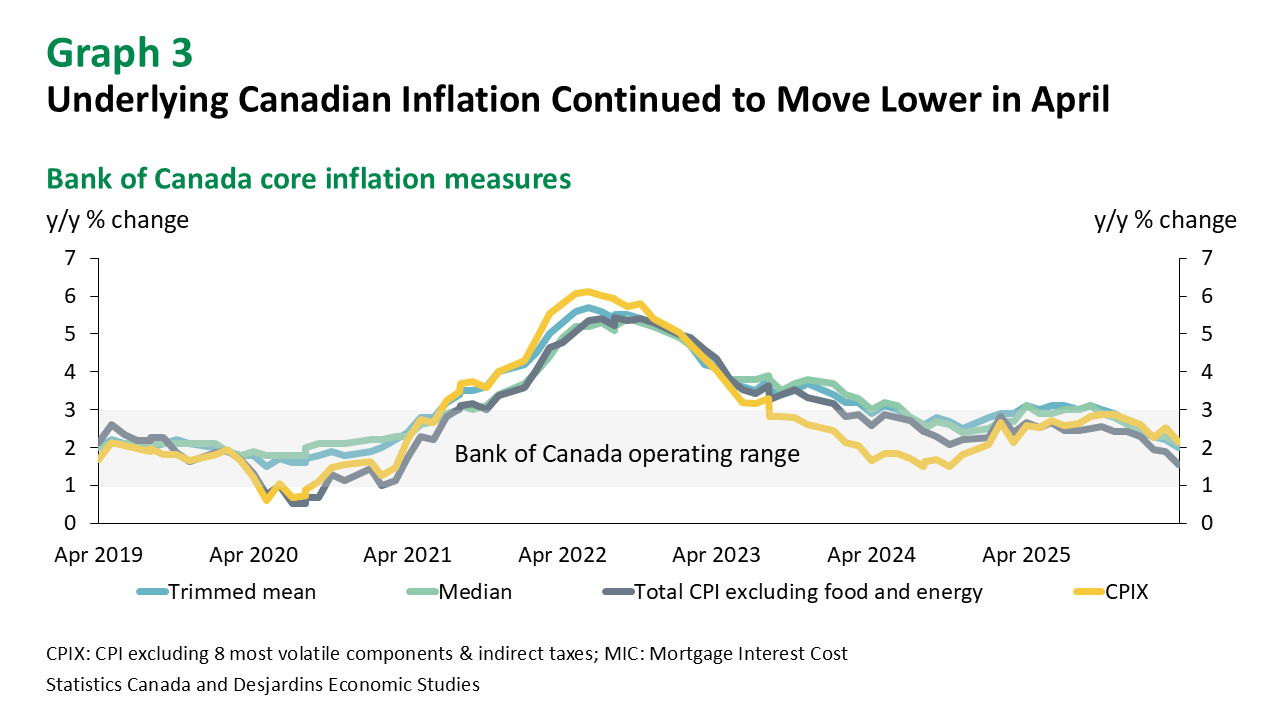
Importantly, higher energy prices don’t seem to be noticeably spilling over into underlying inflation yet (graph 3). The average of the Bank of Canada’s (BoC) preferred measures of core inflation—CPI median and trimmed mean—edged lower in April to around 2.1% y/y. Total CPI inflation excluding food and energy fell to 1.5% from 1.9% in March. Total CPI inflation excluding the eight most volatile components moved down to 2.1% in April from 2.5% in the prior month. Meanwhile, its annualized seasonally adjusted 3-month moving average declined from 1.5% in March to 1.0% in April. In contrast, when this same calculation is applied to the average of the Bank’s preferred measures, it increased from 1.6% in March to 1.8% last month—still below the BoC’s 2% target.
Implications
Today’s softer-than-expected inflation print should give the BoC ample room to remain patient. Our latest price forecast External link. had inflation peaking in Q2 2026 and gradually slowing thereafter. While there could still be surprises on the horizon, this suggests the worst of the price increases could be behind us. That said, high prices are likely here to stay for some time. That should boost exports, investment and national income while putting downward pressure on consumption External link.. Add to this the uncertainty of the Canada-United States-Mexico Agreement (CUSMA) review External link., and there are enough downside risks for the BoC External link. to stay on the sidelines for the foreseeable future.