- Nom du rédacteur
- Francis Généreux
Lead Economist
Weekly Commentary
United States: Will Housing Be a Factor in the Midterms?
October 30, 2026
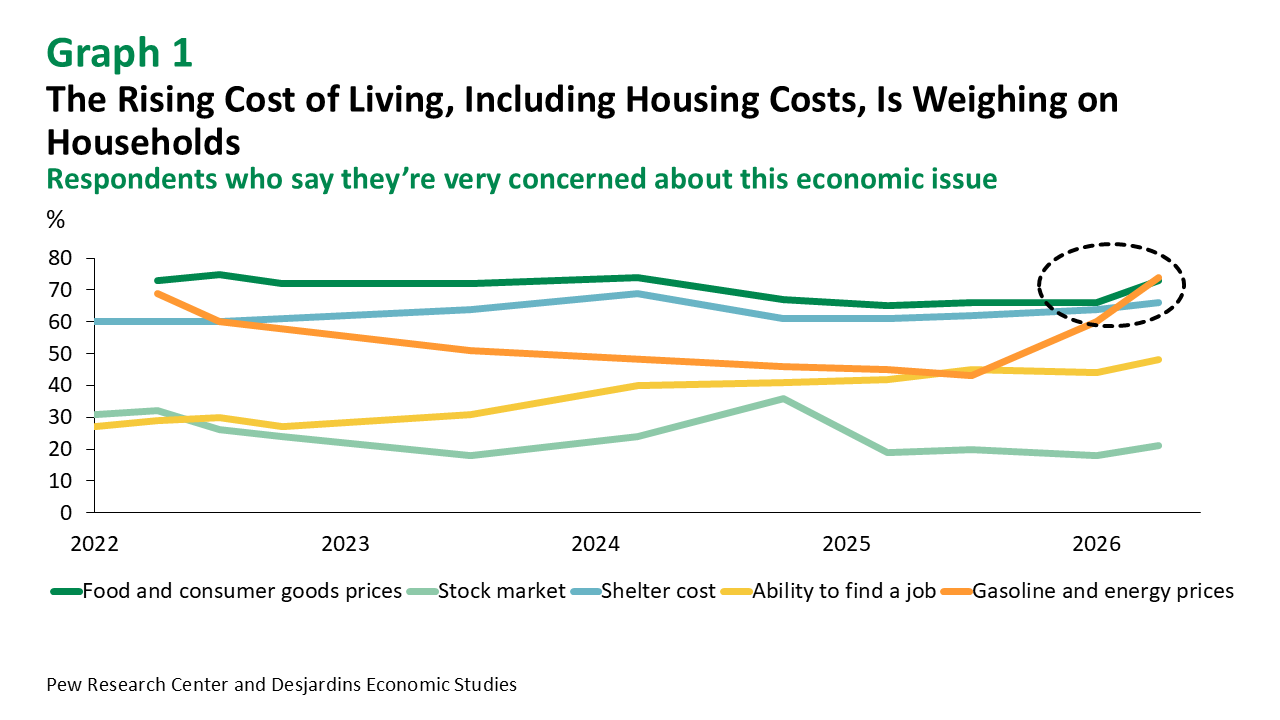
The November 3 midterm elections are just a few days away. As we recently explained in our analysis of the main election issues External link., the rising cost of living is central to the campaign. This issue is multifaceted. The war in Iran and its impact on oil prices have exacerbated household concerns about energy and gasoline prices, as shown by a recent Pew Research Center survey External link. (graph 1). Food and consumer goods prices also remain a concern. The third most important aspect is the difficulty of finding affordable housing. Home prices remain high despite the housing market slowdown, while the recent rise in mortgage rates has done nothing to ease US voters’ concerns.
Are US politicians on the campaign trail—or the Trump administration, which will remain in place for another two years—offering any simple solutions to make housing more affordable? Everyone wants to improve affordability, making housing one of very few issues on which both parties agree. But fiscal, trade and immigration policies have complicated matters.
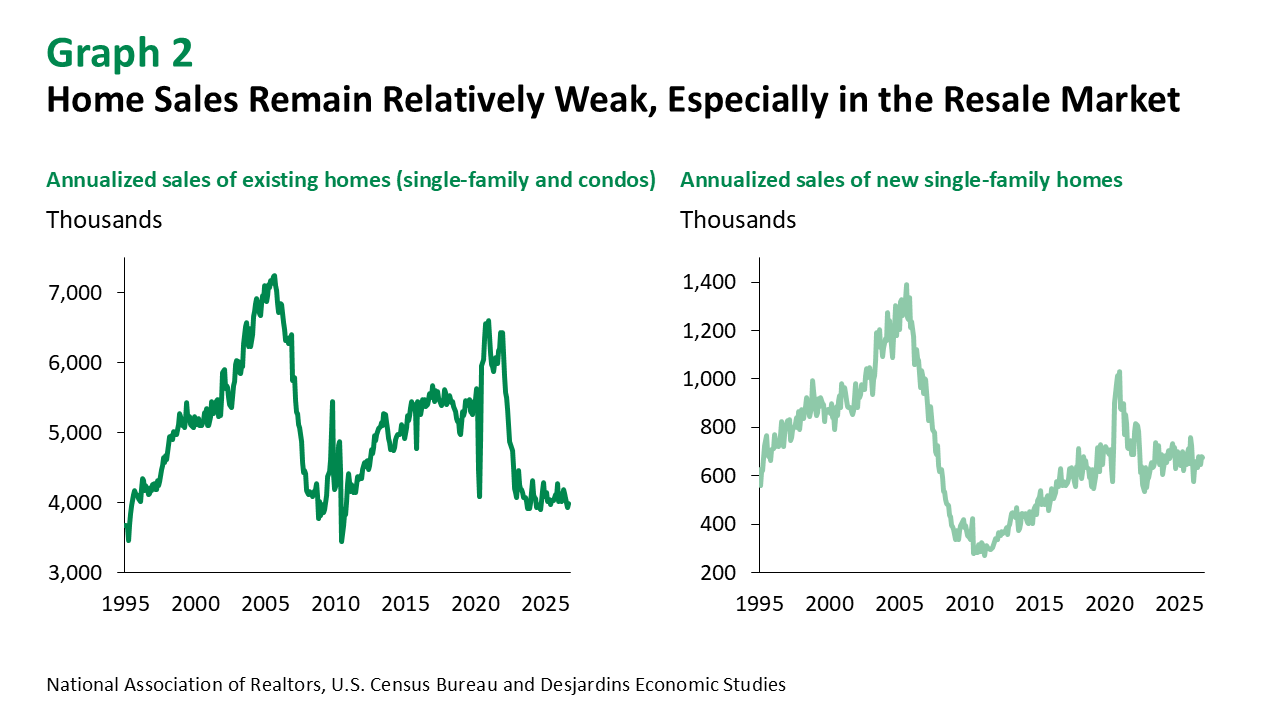
We also need to recognize that improving housing affordability in the US won’t be easy as long as mortgage rates remain high. Mortgage rates are obviously affecting demand. The Federal Reserve’s Senior Loan Officer Opinion Survey on Bank Lending Practices reported weaker demand, which is also reflected in the 21.6% decrease in mortgage applications for home purchases since mid-May. High rates are also affecting supply. Homeowners who secured long-term loans at very low rates during the pandemic are now reluctant to sell because they’d have to take out a new mortgage at a much higher rate. This lock-in effect has frozen the resale market and is helping keep sales low (graph 2).
Solutions Are Focused on Boosting Supply
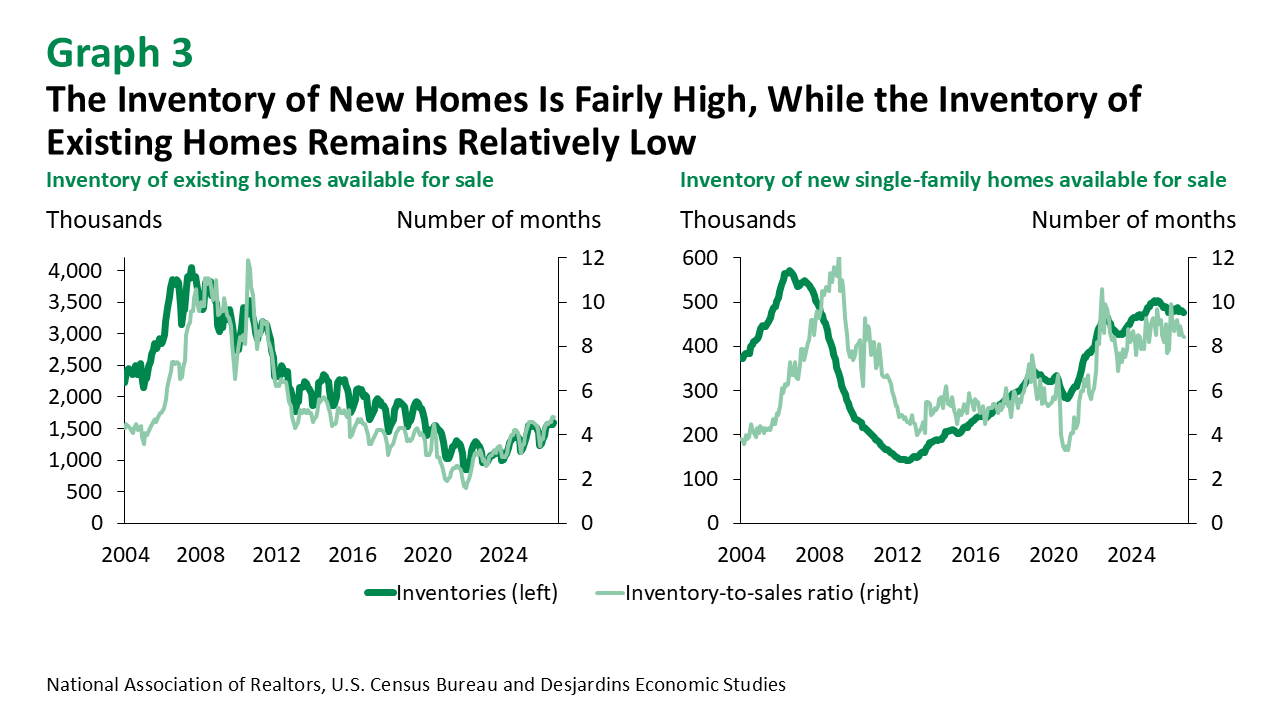
The housing policies coming out of Washington generally aim to increase supply. This includes encouraging more construction, which would help ease some of the pressure on affordability. But current market conditions don’t necessarily indicate a major supply imbalance. In fact, the inventory of new homes for sale is currently high (graph 3, right). The inventory of existing homes for sale isn’t as high, but it’s still up from the post-pandemic low (graph 3, left). So it’s hard to argue there’s a severe housing shortage. Conditions in the rental market aren’t particularly alarming, either. Rental vacancy rates are relatively high, and several indexes indicate that rents are even declining. Conditions can, of course, vary by region and especially by housing and income segment. However, at the national level, the problem appears to stem more from sticky home prices and high interest rates than from a dire shortage of supply.
A Rare Bipartisan Breakthrough: An Encouraging Example for the Second Half of Trump’s Term
One supply-focused housing policy is the 21st Century ROAD to Housing Act, which became law on July 11, 2026. It was the result of a rare bipartisan effort. After several versions and a number of compromises in both chambers of Congress, the final text passed by a vote of 85 to 5 in the Senate and 358 to 42 in the House of Representatives. President Trump refused to sign it into law, not because he disagreed with it, but to protest the Senate’s failure to pass the SAVE America Act, which sought to tighten voter ID requirements. But since he didn’t veto the bill, it nevertheless became law 10 days (excluding Sundays) after it was sent to the White House, in accordance with constitutional rules.
Despite Trump’s inaction, the bipartisan nature of the legislation is noteworthy. It suggests that Congress can find ways to work together on issues where opinions aren’t sharply divided. Housing is one such issue because it affects nearly every segment of society. This legislative compromise is broad in scope. It mostly cuts red tape to facilitate permitting and new construction. It also relaxes the rules for prefab homes and strengthens several federal programs. One of its most talked-about provisions prohibits large institutional investors from acquiring more single-family homes.
Before the 21st Century ROAD to Housing Act was passed, President Trump also issued two executive orders on housing in March 2026. They aimed to ease federal regulations—especially environmental ones—on residential construction, establish best practices for states and municipalities to accelerate the permitting process, and facilitate mortgage financing. However, those executive orders don’t have the same scope as the legislation passed by Congress, which enacts a series of reforms affecting supply, financing and several federal housing programs.
Other Trump Administration Policies Are Undermining Affordability
Although these measures help, they won’t solve all of the problems with the housing market. More importantly, they don’t ensure that more housing can be built at affordable prices. Some of the constraints on building more affordable housing are directly related to other Trump administration policies.
First, there are the tariffs. Many of the materials and types of equipment needed for construction are now subject to tariffs that didn’t exist two years ago. Despite prolonged weakness in residential and non-residential construction, producer prices for building material and supplies dealers increased by 26.3% over the last two years. A year ago, the Brookings Institution External link. estimated that tariffs would inflate residential investment costs by US$30 billion.
Immigration is also an issue, although its effects are more complicated. Immigrant workers play a major role in the construction industry. More restrictive immigration policies and increased enforcement, including arrests and deportations, have reduced the available workforce in a sector where labour shortages were already significant. According to a study by the National Bureau of Economic Research cited by The New York Times External link., construction employment fell by 7.5% for undocumented workers. What’s more, the deportations are also affecting US‑born workers. For every arrest by Immigration and Customs Enforcement, six American-born workers lost a job, and four undocumented workers lost one. But there’s another side to the issue. Reducing immigration also reduces housing demand. The net impact on affordability therefore remains unclear.
Another competitor has also emerged for some of the resources needed in construction: data centres. A growing share of the US population already disapproves of them, and the issue has now made its way into the midterm election campaign. Data centres may also affect the housing market. The current AI boom requires massive amounts of capital, which puts upward pressure on interest rates. It also requires specialized workers, equipment and other resources used in construction. Survey respondents also believe that data centres are driving up utility costs.
What If There Really Is a Blue Wave?
For now, the polls indicate that the Democrats could make big enough gains to win majorities in both the Senate and the House of Representatives. However, the election results likely won’t trigger a complete reversal of housing policy. Bipartisan support for the 21st Century ROAD to Housing Act suggests that there’s already common ground on which the two parties and the White House can build if they choose to do so.
That said, there are also clear differences. The Democrats will likely seek to provide more assistance to households, promote affordable housing and introduce measures to help first-time homebuyers. With Republican support, they could also try to lower tariffs on construction equipment and materials. Democratic members of Congress have already introduced legislation to this effect: the Housing Tariff Exclusion Act. A Democratic majority would also oppose the current immigration policy and could limit its funding, which would reduce its negative impact on labour supply in the construction industry. However, as we noted in our October 14 analysis of the midterm elections, there are limits to what a Democratic-controlled Congress could accomplish without the approval of the US president.
Interest Rates Remain the Key Issue
Despite politicians’ best intentions, interest rates continue to be the main economic issue affecting affordability. The solutions proposed so far probably won’t be enough to meaningfully improve affordability if mortgage rates remain high.
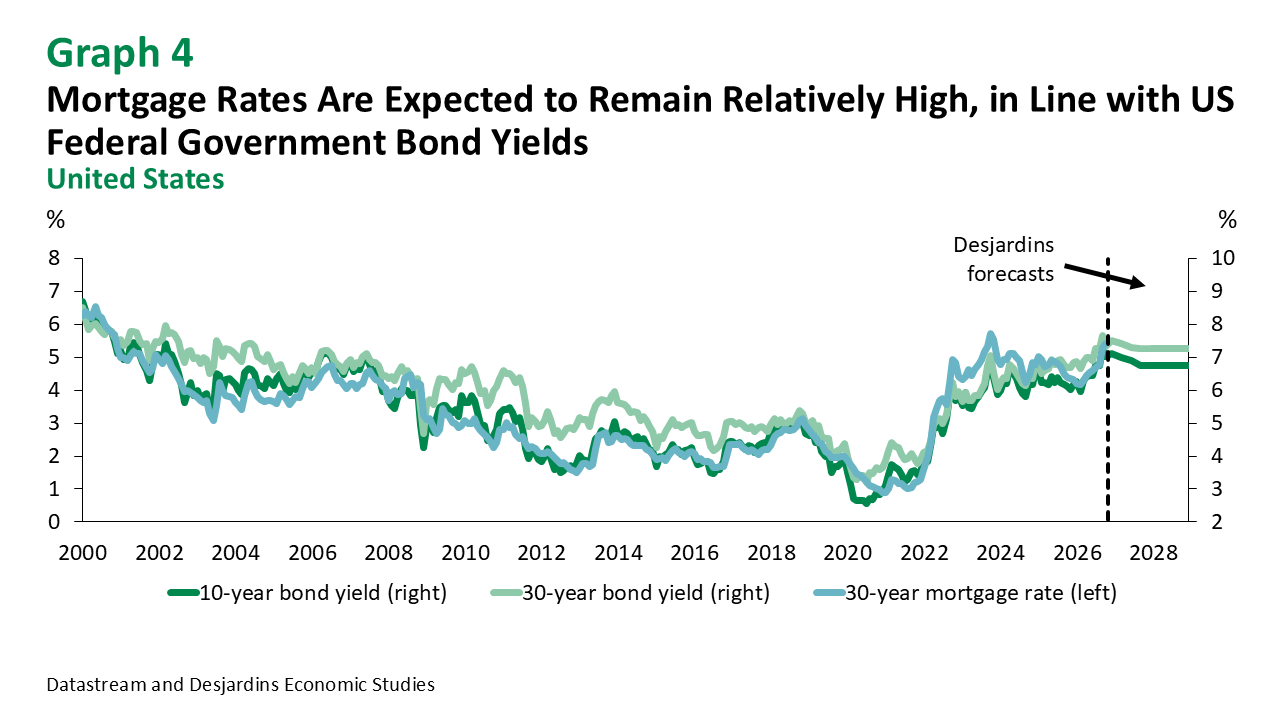
Several factors are keeping them high and could continue to do so for some time (graph 4). Inflationary pressures intensified by the war in Iran are influencing market expectations and pushing up bond yields and, by extension, mortgage rates. Demand for capital is also strong in the US and elsewhere. We’ve already discussed the investments needed to develop and deploy artificial intelligence. Of course, the private sector isn’t the only one that needs funding. Public sector finances are also adding to the pressure. The US federal government ended fiscal 2026 with a deficit of US$1.99 trillion, equivalent to approximately 6% of GDP. As at September 30, debt held by the public stood at US$32.43 trillion. Against this backdrop, if the decisions made by the White House and Congress over the next few years further weaken public finances, it could make it harder for families to buy homes. This could have a greater impact on affordability than all the regulatory measures and incentives already adopted. If so, housing affordability and the high cost of living could once again loom large in the 2028 presidential campaign.