
- Nom du rédacteur
- Francis Généreux
Lead Economist
Weekly Commentary
How Long Can US Consumers Keep Spending?
November 20, 2026
With American Thanksgiving just around the corner and Black Friday sales set to kick off the holiday shopping season shortly thereafter, it’s a good time to ask whether US consumers will rise to the challenge once again. Expectations are high again this year. The National Retail Federation (NRF) forecast External link. calls for holiday spending to grow by 4.2% in 2026, following a 3.1% gain in 2025. The NRF also expects holiday spending to exceed US$1 trillion for the first time. Next weekend will be especially important for retailers. According to an NRF survey, nearly 203 million consumers shopped between Thanksgiving and Cyber Monday 2025.
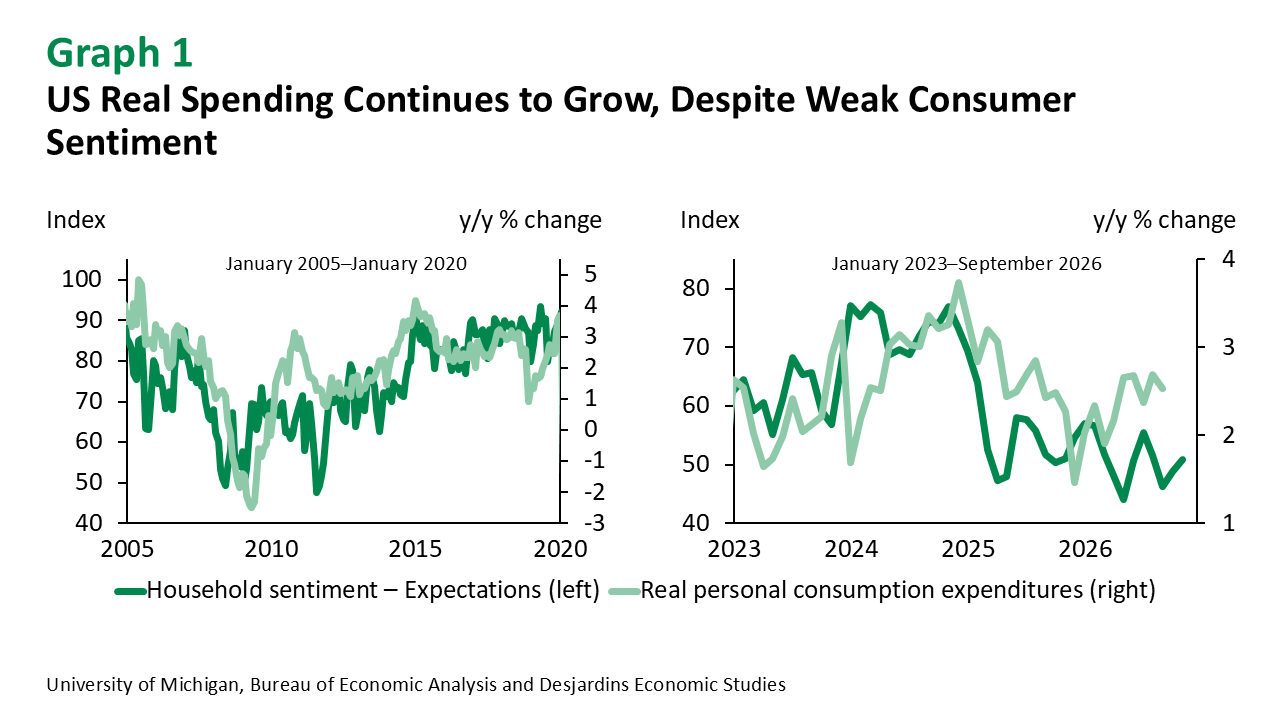
This optimism is being fuelled by the remarkable resilience US consumers have shown since the start of the year, despite more challenging conditions. As the November 3 midterm results made clear, Americans appear frustrated with the economy and, above all, the high cost of living External link.. Yet real consumer spending grew at an annualized rate of 3.8% in both the second and third quarters, the strongest showing since 2024. The contrast between consumer behaviour and sentiment is striking, as confidence indexes are at levels that, before the pandemic, would have been associated with a struggling economy (graph 1). According to the Chicago Fed External link., the weaker correlation between consumer sentiment and spending largely reflects the pandemic’s economic repercussions, as well as changes in survey methodology, some of which were also prompted by the pandemic.
The recent decline in gasoline prices is another encouraging sign for households. Since mid-September, prices at the pump have fallen by 70.4 US cents per gallon, or 16.2%. Prices remain relatively high, but the decline will still provide consumers with some relief. Mortgage rates have also fallen from their early October peak. However, consumers still have reason for concern and frustration. October’s jump in food prices was the highest since April. Another negative factor is the broad stock market sell-off, which has lasted nearly two months.
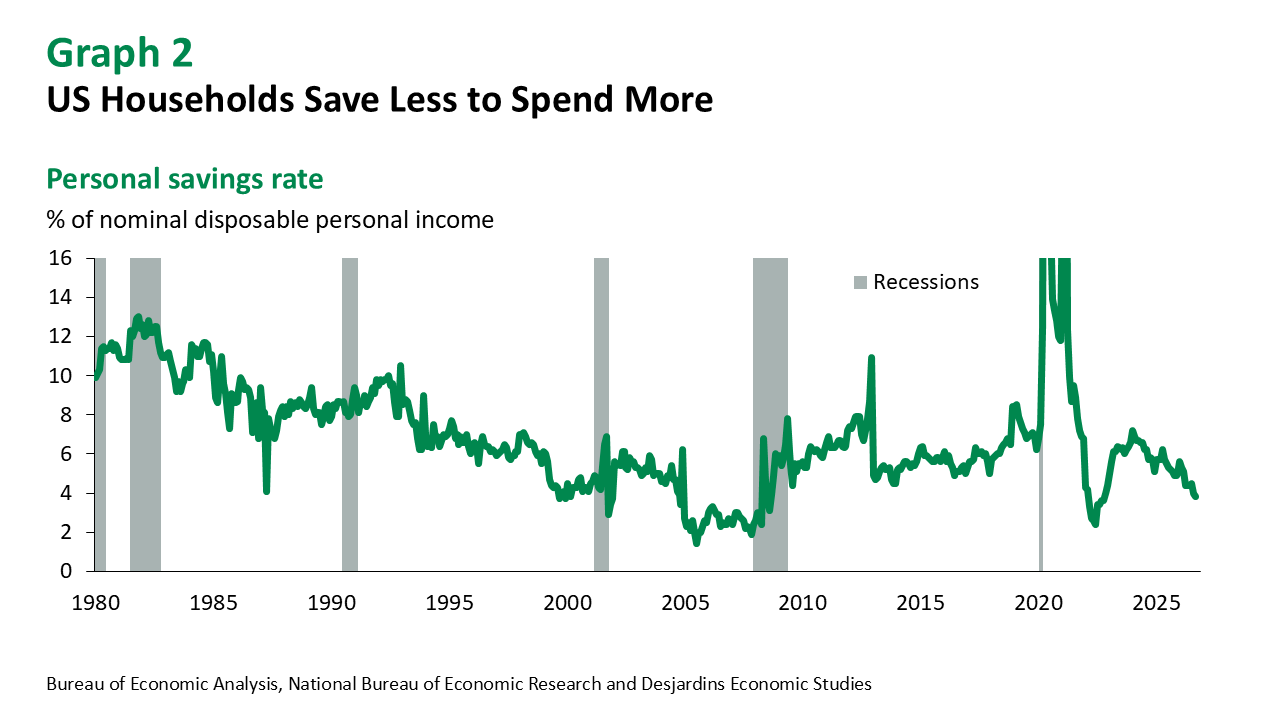
Household spending growth is generally constrained by income growth, which is currently quite weak. Over the past six months, real disposable income has increased by just 0.4% in total. Prices have soared since the start of the war in Iran, which is clearly one of the main reasons for weaker growth. Labour income and government transfers have also grown more slowly. Yet real consumer spending rose by 1.8% over the same six-month period. Most of that increase came at the expense of savings, meaning the share of income that isn’t spent. The household savings rate fell to just 3.8% in September, the lowest level since summer 2008, excluding pandemic-driven declines (graph 2). The downward trend in savings since the post-pandemic peak in winter 2024 has been hard to miss. But there’s a floor to how far the savings rate can fall. Just as there’s a limit to how much debt consumers can take on, there’s also a limit to how far they can reduce the share of income they set aside. With the holiday season approaching, the weak savings rate could support retail spending in the near term but poses longer-term risks. Except when driven by changes in fiscal policy, similar declines in household savings rates have been associated with periods of personal financial stress, such as a rising cost of living or higher interest rates, or episodes of market exuberance that have sometimes preceded recessions. In contrast, recessions tend to create conditions where anxious households increase their savings despite falling incomes.
Economic disparities may also help explain why consumer spending has remained resilient even as confidence has faded and real income growth has weakened. In recent years, both the US economy and consumer spending have often been described as K‑shaped. This suggests that growth has been driven by households with the highest incomes or substantial financial assets, while less affluent households remain more vulnerable to shifts in economic conditions, confidence and the cost of living. The views of less affluent households may dominate surveys, but spending by wealthier households boosts total consumption. According to research by the New York Fed External link., this dynamic was clearly significant from 2023 to early 2026, but more recent data External link. suggest a more even pattern across households. Greater stock market volatility and the risk that a potential bubble in AI stocks could collapse may even cloud the outlook for households with substantial financial assets. Consumer confidence remains much higher among households with large stock holdings. However, over the past six months, the University of Michigan consumer sentiment index has fallen just as much for these households as it has for those with no stock holdings at all.
Finally, the resilience of consumer spending may also have a more structural explanation: how its composition has changed since the pandemic. Some spending categories that are becoming more important seem to be less directly tied to consumer sentiment (graphs 3 to 5). This is particularly true of durable goods, where growth has been driven largely by software and tech products, which may be less discretionary than they once were. Among nondurable goods, spending on pharmaceuticals is showing the clearest upward trend. As with food, it’s generally harder to cut back on these purchases when confidence fades. In services, growth is mainly driven by health care, which accounts for a growing share of spending. Health care spending is also harder to reduce, as is housing, which likewise represents a large share of consumer spending. In short, the changing composition of consumer spending has probably made it less sensitive to shifts in economic conditions or confidence.


These factors suggest that US consumers will once again come through this holiday season. Despite monthly fluctuations, the relatively solid labour market External link., along with the decline in gasoline prices, could provide a near-term boost to consumer spending. That said, current economic conditions can hardly be described as entirely favourable. With the savings rate already low, households have little room to sustain spending growth that outpaces their incomes. The concentration of growth among more affluent households poses another risk, especially in the event of a market correction. Given these risks, the real question is whether consumer resilience can last throughout 2027.