
- Nom du rédacteur
- Laura Gu
Senior Economist
Economic Viewpoint
Desjardins Provincial Outlook
Canadian Provinces Are Faring Better than Expected, but the Resilience Is Uneven
October 29, 2026
Highlights
- National economic performance is masking a deep regional divide. Recent data show more resilience than we expected. Exports recovered in autos and got a lift from energy and mining through the middle of the year, while most other tariff-exposed sectors stabilized. Robust hiring through the summer kept unemployment in check in most provinces, and retail sales gained momentum even excluding gasoline.
- That strength appears concentrated, with Alberta leading on both jobs and spending, while Quebec trails on jobs and British Columbia (BC) on both. Ontario has surprised on the upside, narrowing its growth gap with the rest of the country.
- Growth is set to slow in the second half of the year. The revised Section 338 list hits Ontario, Quebec, BC and Nova Scotia hardest, while Canada’s proposed counter-tariffs would weigh most heavily on the Prairies and Ontario.
- Business investment should support the recovery, but the project pipeline favours resource regions. Real non-residential investment rose in every province in the first half of 2026, led by BC and Atlantic Canada. The major projects pipeline presented at the Canada Investment Summit leans heavily toward mining, energy and LNG, so the bigger medium-term investment gains ahead are likely to favour BC, Alberta and Atlantic Canada.
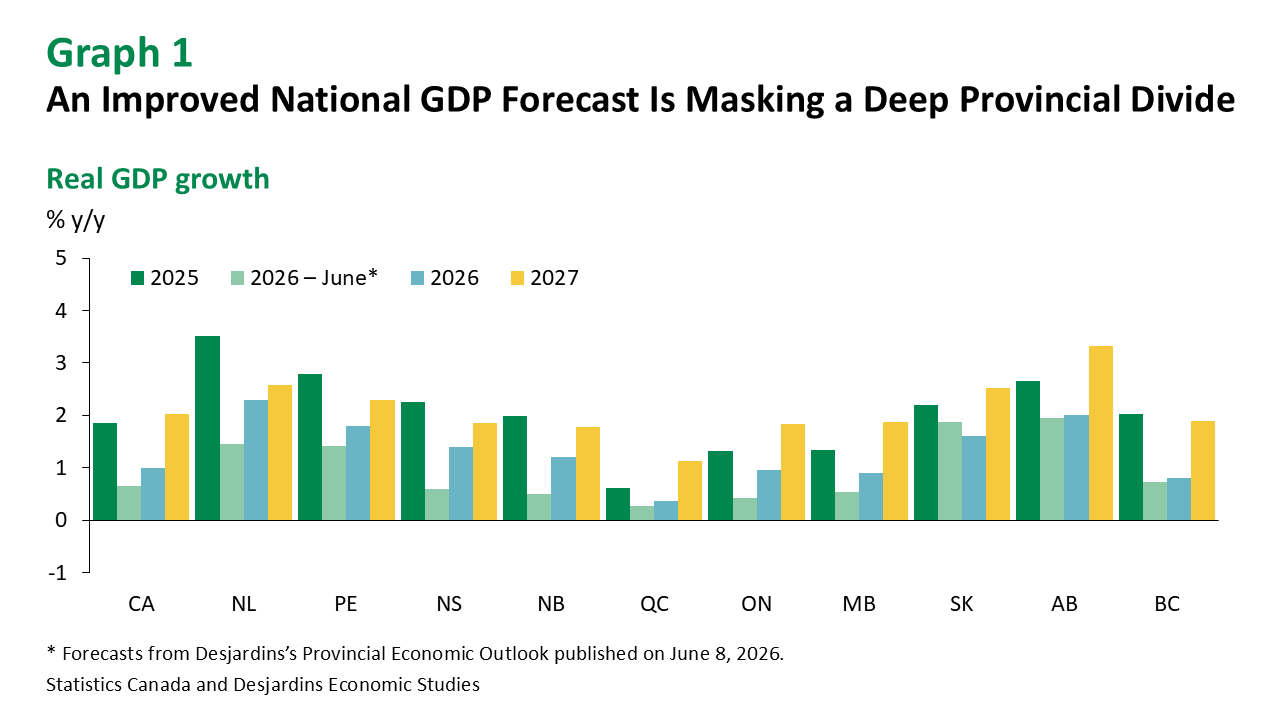
- Stronger recent activity has lifted our forecasts, with an investment-led rebound expected next year. We have upgraded our 2026 and 2027 growth forecasts relative to our June Provincial Outlook, but the regional picture remains uneven (graph 1). Growth is expected to rebound in all provinces next year as investment picks up, with Alberta and BC expecting the largest acceleration.
- The population slowdown has been milder than previously believed, for now. The latest revisions show a much smaller drop in non-permanent residents than first estimated. As a result, immigration kept Ontario, Quebec and BC growing instead of shrinking. Meeting Ottawa’s 5% target by 2027 would now require population declines in most provinces, but we view hitting this target as unlikely.
- Higher energy prices have pushed inflation up unevenly across provinces. Provincial gaps should narrow in 2027 as inflation eases gradually.