- Nom du rédacteur
- Laura Gu, Senior Economist • Kari Norman, Senior Economist
Ontario budget
Ontario: Fall Economic Statement 2026
Revenue Headwinds Warrant a Prudent Plan
October 29, 2026
Highlights
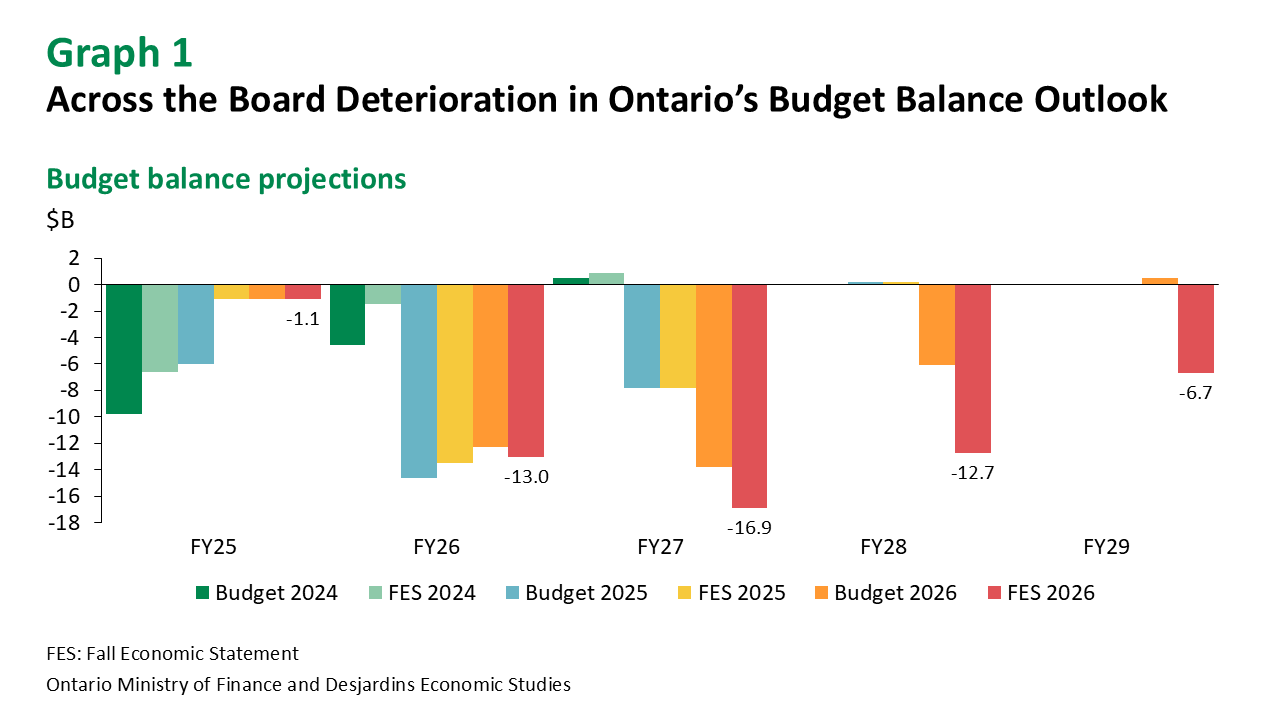
- Ontario’s 2026 Fall Economic Statement (FES) widens the deficit projections in every year of the plan and pushes balance back another year to FY29–30 (FY30). The FY27 deficit is now projected to be $16.9B (1.3% of nominal GDP), up from $13.8B (1.1%) in Budget 2026. It then narrows to $12.7B in FY28 and $6.7B in FY29, before turning a small surplus in FY30 (graph 1). Table 1 summarizes the key fiscal indicators.
- The deterioration is mainly due to increased buffer for future spending and lower-than-expected growth in tax revenues. About $7.4B of the $16.9B cumulative deterioration comes from a larger reserve and a top-up to the Contingency Fund. On revenue, a $2.0B gain this year turns into shortfalls of $3.9B and $4.9B in the outer years.
- Debt ratios are drifting higher despite a stronger nominal GDP starting point. Net debt-to-GDP edges down to 37.4% in FY27 but rises to a peak of 38.9% in FY29, compared with a peak of 38.5% in FY28 in Budget 2026. It is projected to ease in FY30 once the budget is balanced. Interest-to-revenue also climbs, reaching the province’s 7.5% ceiling outlined in its Debt Burden Reduction Strategy in FY29.
- Growth-oriented measures dominate new policy announcements. Matching the federal Productivity Mega Deduction delivers more than $8B in business tax relief over five years and is expected to attract at least $11B in additional investment. Its cost is largely covered by a larger reserve. The FES adds expanded R&D credits, wider access to tariff-relief funds and loans, and a joint federal–provincial auto and steel package. New program spending is limited to $1.4B over three years (FY27 to FY29).
- Total funding requirements have increased relative to Budget 2026 by $13.5B over the three fiscal years starting in FY27. Most of the extra funding still comes from the long-term market, where borrowing increased by $11.5B over the period. FY27 long-term borrowing is forecast at $51.1B compared with $47.2B in Budget 2026, and the province had completed $36.3B, or 71%, of this year’s program by October 8. Requirements are also higher than planned in the outer years: $48.0B in FY28 (vs. $43.1B) and $45.4B in FY29 (vs. $42.7B). Ontario is leaning more on the short end, adding $8.0B of short-term debt this year compared with $6.0B planned, and launching a Euro-Commercial Paper programme.