- Nom du rédacteur
- Jimmy Jean, Vice-President, Chief Economist and Strategist
Mirza Shaheryar Baig, Foreign Exchange Strategist
FX Analysis
Is the Loonie a Value Trap?
November 5, 2026
Highlights
- The Canadian dollar has become very undervalued on purchasing power parity models.
- We believe some of the structural headwinds that have weighed on the currency may be fading.
- A nascent investment cycle, potentially less capital chasing US AI stocks and narrowing US-Canada rate differentials should support CAD in coming months.
- The ECB is choosing between price stability and financial stability. The euro is paying the price.
- The yen may be regaining its former status as a safe haven.
- The Chinese yuan remains undervalued. We expect further strength.
- With the MXN carry trade largely unwound, the currency may be nearing a bottom.
Overview
Cheap Is the Easy Part
On most conventional valuation metrics, the Canadian dollar looks significantly undervalued.
We estimate the currency is around 22% undervalued against the US dollar on a classic purchasing power parity (PPP) model, which assumes exchange rates ultimately adjust to differences in price levels across countries (graph 1). Historically, USDCAD overshoots have peaked at around 20-25% and taken roughly three years to fully unwind once they exceeded 20%. The current overshoot is already 20 months old.

The real effective exchange rate (REER), which measures CAD against a basket of trading-partner currencies adjusted for inflation, tells a similar story. The Bank of Canada’s REER index has fallen to around 102, near the bottom of its 25-year range and back to levels last seen in the early 2000s (graph 2).

But cheap currencies can stay cheap for a long time. As any value investor will tell you, the multiple is usually low for a reason. And for the loonie, at least three reasons stand out: low productivity, a decade-long capex slump, and the US AI boom drawing Canadian capital south.
Productivity drag: Labour productivity growth in Canada has lagged the US over the past decade, eroding the competitiveness of Canada’s non-commodity tradable sector (graph 3). While productivity can be measured in different ways, real output per hour worked has grown about 1.1% per year slower in Canada than in the US over the past 10 years. A weaker currency has helped compensate for that gap. We estimate that differences in productivity growth explain more than half of the current deviation of USDCAD from PPP.

Capex slump: Non-residential investment in Canada has been hovering around 15% of GDP for 10 years and hasn't recovered after the shale oil boom ended (graph 4). Commodity booms have historically supported the Canadian dollar by stimulating domestic investment and jobs. But that transmission has weakened considerably as resource companies have prioritized returning cash to shareholders and strengthening their balance sheets. We believe this helps explain why the relationship between energy prices and CAD has weakened in recent years.

Equity outflows: Canadian investors have piled into US stocks in recent years. The move began with the post-pandemic boom in technology stocks and accelerated as AI came to dominate global equity returns. With relatively little exposure to the AI theme in the domestic market, Canadian investors have increasingly had to look south for growth.
While inflows to Canadian debt securities from US-based investors have picked up recently, bond investors are more likely to hedge the currency risk than equity investors. As such, portfolio flows have been a persistent headwind for the Canadian dollar.

The Tide May Be Turning
We remain optimistic on the loonie over the medium-term.
The clearest reason is investment. After a decade of underinvestment, the policy environment in Canada has shifted decisively, especially towards expanding the resource sector. The Bank of Canada expects business investment to strengthen modestly next year. It will take time to rebuild momentum, but the investment cycle finally appears to be turning.
There are tentative signs of a shift in portfolio flows as well. Investors appear worried that the AI hyperscalers may not generate sufficient revenues to justify the massive infrastructure spend. If investors become less willing to chase the AI theme, the pull of Canadian capital south could begin to fade.
However, the productivity gap may continue to be a drag for the loonie. Productivity growth in the US is likely to remain strong due to ongoing deregulation and AI adoption. While Canadian businesses appear to be ramping up AI adoption according to a survey External link. by Statistics Canada, we would be cautious about assuming a meaningful narrowing in the productivity gap between the US and Canada on a tradable horizon.
Focus on Rate Differentials and Trade Talks for Now
The Bank of Canada hiked rates by 25bps last week while the Federal Reserve kept rates unchanged. Both decisions were in line with our expectations, but the BoC’s higher inflation forecast suggests the central bank may hike at the December meeting as well. Meanwhile traders have pared back expectations of Fed rate hikes.
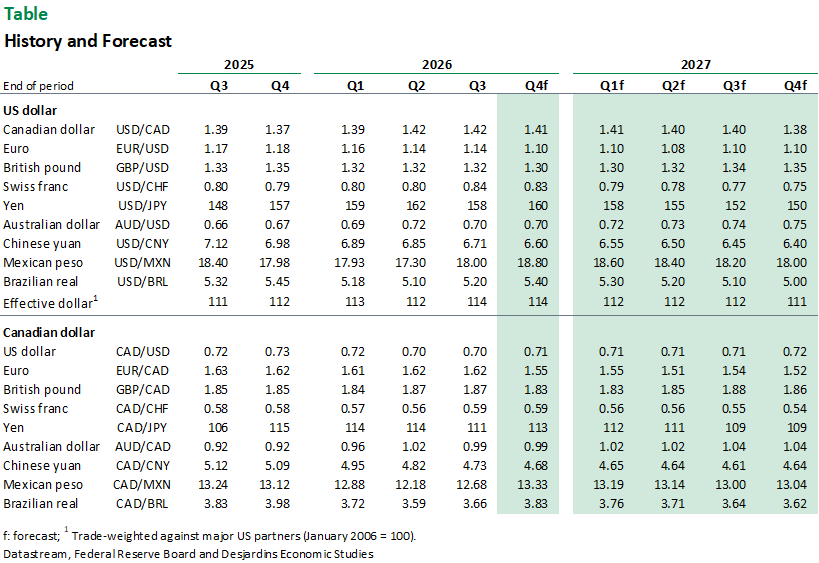
The spread between 2Y USD and CAD swaps has narrowed to about 125bps, down from a high of around 155bps. USDCAD has followed these rate differentials very closely (graph 6). We believe there is scope for rate differentials to narrow further in coming months, particularly if we're right on the view that the Fed will end up cutting rates next year. As such, we’re forecasting a gradual decline in USDCAD to 1.38 next year.

Finally, we expect trade-related news to be more prominent into the end of the year. It appears the US and Canada are re-engaging on some level, though Mark Carney described it as a “slight intensification” of discussions. Market expectations are low, thus any progress towards a trade deal would be a positive catalyst for CAD. Still, the clock is ticking, with President Trump’s threat to raise tariffs on all Canadian autos to 50% on January 1, 2027, still hanging over the negotiations.
EUR
Winter Is Coming
We remain bearish on the euro. With winter approaching and energy markets still facing disruptions, TTF natural gas futures have risen past EUR100/MWh for the first time since 2022. Meanwhile the French bond market remains under pressure, with investors remaining wary about the lack of political will to address fiscal challenges. Against that backdrop, the ECB faces a difficult trade-off between price stability and financial stability. It opted to keep rates unchanged last week and acknowledged that downside risks to growth were becoming prominent. We expect the euro to remain under pressure.
JPY
Safe Haven Again?
The Bank of Japan held rates at 1.25% last week, in line with market consensus. However, the central bank gave two signals to expect more rate hikes are coming. First, the BoJ acknowledged that underlying inflation has met the 2% price stability goal, and second, the monetary policy report noted that financial conditions have remained accommodative despite recent weakness in the equity market. We expect a 25bps hike in December, and at least two more rate hikes next year. In addition, the recent drop in US bond yields amidst weakness in equity markets suggests the traditional relationship between risk sentiment and safe havens may be reasserting itself. We believe the JPY may be a surprise winner if the correction in AI-related equities continues, despite the fact that Japan is a major exporter of semiconductors.
CNY
The Trend Is Your Friend
We expect the Chinese yuan to continue appreciating. China’s enormous trade surplus, which rose to a record USD133 billion for the month of September, has created a persistent glut of dollars that state-owned banks are forced to absorb in order to slow the renminbi’s advance. The scale of this “stealth” intervention suggests the currency remains well below its market-clearing level. Chinese authorities often push back on claims that the yuan is undervalued, but their actions suggest they are willing to tolerate a gradual appreciation of the currency.
MXN
Carry Unwind May Have Run Its Course
The Mexican peso has cheapened considerably in the last two months. The weakness was initially triggered by rising expectations of Fed tightening and then exacerbated by the breakdown of bilateral trade talks with the US. The large reaction in markets was likely due to the overhang of carry trades in the currency, which have now mostly unwound. We expect the peso to remain sensitive to risk sentiment, but we believe a large part of the adjustment is now behind us.
Forecast Table