
- Nom du rédacteur
- Randall Bartlett, Deputy Chief Economist • LJ Valencia, Economist
Economic News
Canada: The Canadian Immigration Plan–Different Packaging, Same Approach
November 9, 2026
Comments
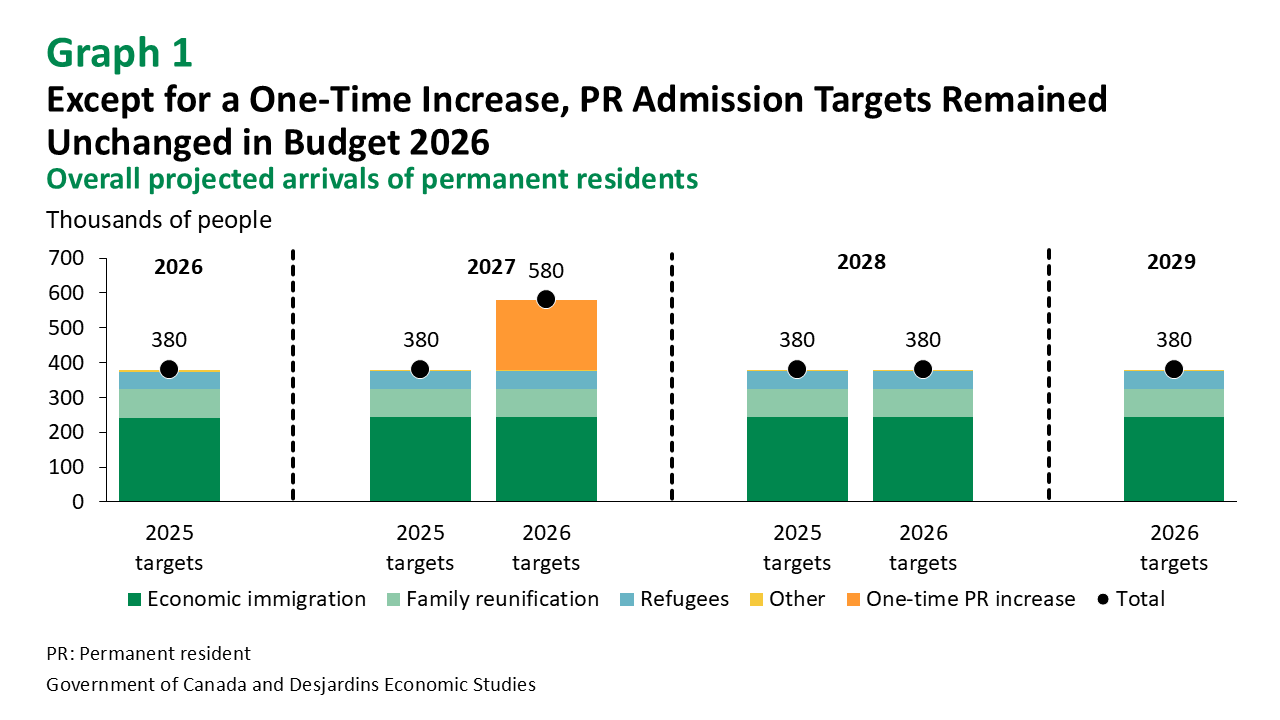
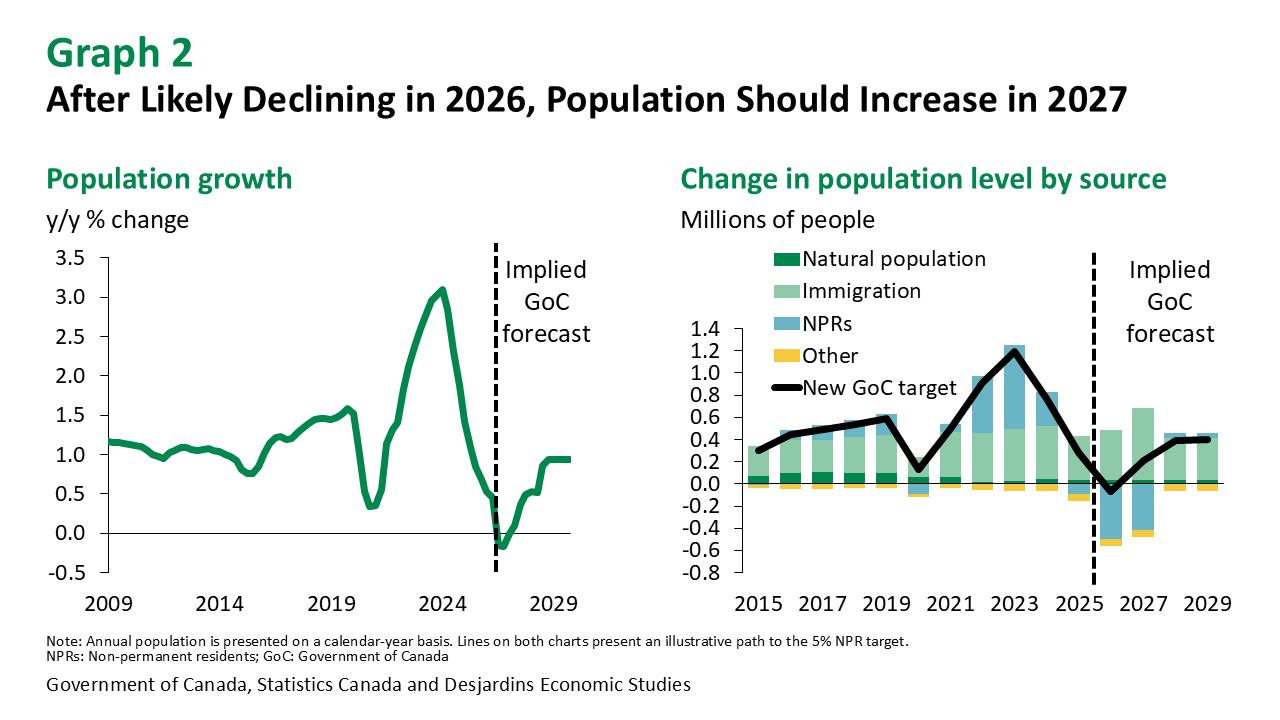
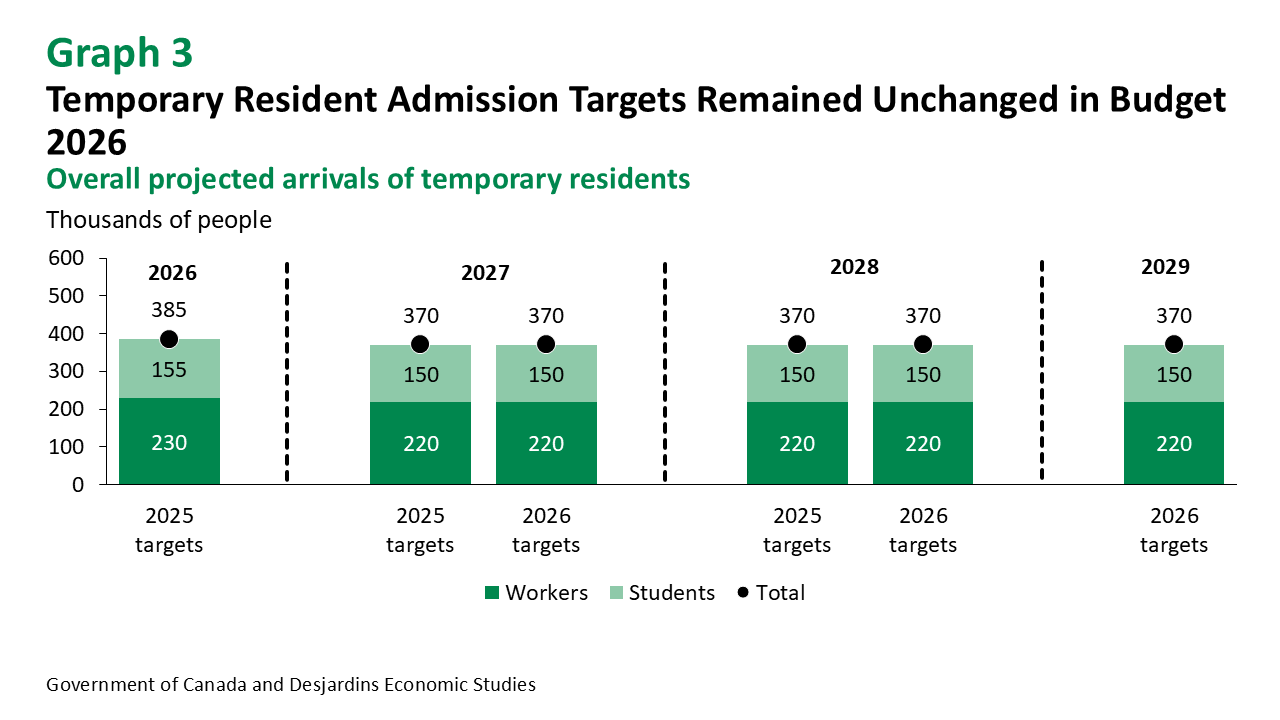
Canada’s latest immigration strategy appears to be more like a replay than a revamp. In Budget 2026, the federal government announced plans to keep permanent resident and temporary resident admissions at 380k and 370k annually for the next three years, respectively. That’s identical to the previous targets. However, the plan includes a new measure to transition an additional 200k temporary residents to permanent residency status by the end of 2027 (graph 1). As a result, after possibly being negative in 2026, population growth is likely to turn positive in 2027 (graph 2). That said, if the one-time increase in permanent residents comes in below 200k, population growth will be slower than projected. But that implies the Government of Canada reaches its other immigration targets, which recent upward revisions to population suggest are also at risk of not being met.
The new immigration plan focuses on economic immigration to meet the unique needs of communities and industries. That said, temporary foreign worker targets for the next three years are mostly the same as the last year’s plan (graph 3). The federal government still expects the total number of temporary residents to fall to less than 5% of Canada’s population. However, it now appears less committed to doing that before the end of 2027 (although we have maintained that assumption for the forecasts presented here).
However, more action is needed if Canada wants to fulfill its immigration targets. Upward revisions External link. to the quarterly population numbers have complicated the path to achieving this. Canada would need larger net non-permanent resident declines than has so far been the case to reach its non-permanent resident target of 5% of total population.
The goal of this plan is to bring immigration back to a sustainable place and ease pressures on Canada’s housing market, essential infrastructure and services. Against a backdrop of a rapidly aging population, the revised immigration strategy will add to Canada’s long-term labour force stagnation and fiscal strains. Previous research External link. has demonstrated a sharp increase in the dependency ratio even under past immigration targets.
The latest immigration plan does not offer much for cash-strapped post-secondary institutions (PSIs). The new plan maintains the previous targets for international student admissions. Given declining international student enrollment, PSIs could experience persistent fiscal stress External link. in the coming years.
In the near-term, the slowing influx of new workers should help keep the labour supply aligned with subdued demand amid trade-related headwinds. Indeed, the unemployment rate would likely edge higher if not for the slower pace of labour force growth. In addition, easing population pressures should temper rent inflation, as temporary foreign workers and international students tend to rely more on rental housing. In the long-term, a smaller labour supply should also boost wage growth.
The latest immigration leaves our economic outlook broadly unchanged. With the direction of permanent resident admissions targets broadly unchanged except for a one-time increase in 2027, the announcement has little bearing on our outlook for the output gap in Canada. Therefore, we anticipate minimal effects on inflation and the trajectory of the Bank’s policy rates.