
- Nom du rédacteur
- Laura Gu
Senior Economist
Economic News
Canada: Hiring Freeze Pushes Unemployment Higher Despite Limited Layoffs
November 6, 2026
Highlights
- Canadian employment was little changed in October, falling by 4.7k and missing expectations for a 15k increase. The unemployment rate rose 0.2 percentage points (ppts) to 6.7%.
- Total hours worked rose 0.6% month over month (m/m) and year over year (y/y). Average hourly wage growth eased to 2.2% y/y from 2.3% in September. Table 1 summarizes key labour market indicators.
- Our Q3 real GDP growth tracking sits around 1.5% annualized, slightly weaker than the Bank of Canada’s (BoC) latest Monetary Policy Report (MPR). Our early Q4 tracking points to growth slightly near 1%, broadly in line with the Bank's projection.

Comments
Canada’s labour market failed to regain its footing in October. Employment was little changed after losses of 42k in August and 68k in September. It now stands roughly 46k below its December 2025 level and just 17k higher than a year ago.
Private-sector employment fell 53k in October, its first decline since February, with wholesale and retail trade the main drag (‑29k), extending a year-long slide in the sector. The public sector recovered 50k after four straight monthly losses. Construction added 16k, while education and healthcare posted gains of 15k and 14k, respectively.
A shrinking labour force continues to cap the unemployment rate. The participation rate held at 64.8% in October but is down 0.4 ppts from a year ago. Had participation stayed at last year's level, the unemployment rate would be closer to 7.2%. The employment rate slipped for a third straight month to 60.5%, its lowest level since early 2021.
Unemployment has risen for two consecutive months, reversing part of its early-year improvement, although it remains below year-ago levels. Layoffs remain limited, with the layoff rate at 0.7%, virtually unchanged from a year earlier. The problem is hiring. Fewer than one in five unemployed Canadians found work in October, compared with a 24.6% pre-pandemic average. Long-term unemployment accounted for 23.7% of joblessness, up from 17.2% before the pandemic (graph 1).

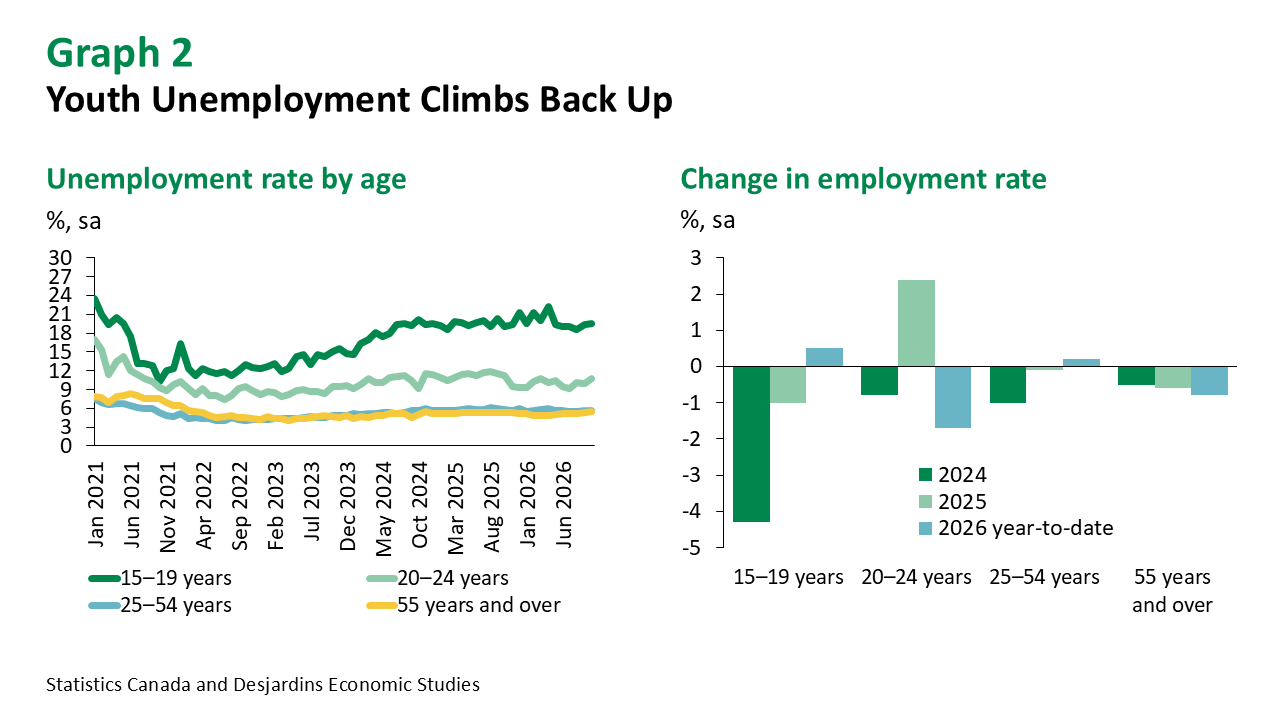
Youth unemployment jumped 0.7 ppts to 13.7% as more young people looked for work and employment fell 11k. Workers aged 20 to 24 bore the brunt, with their unemployment rate approaching 11% and their employment rate down nearly 2 ppts this year (graph 2). Core-aged workers held up, with their unemployment rate steady at 5.6%.
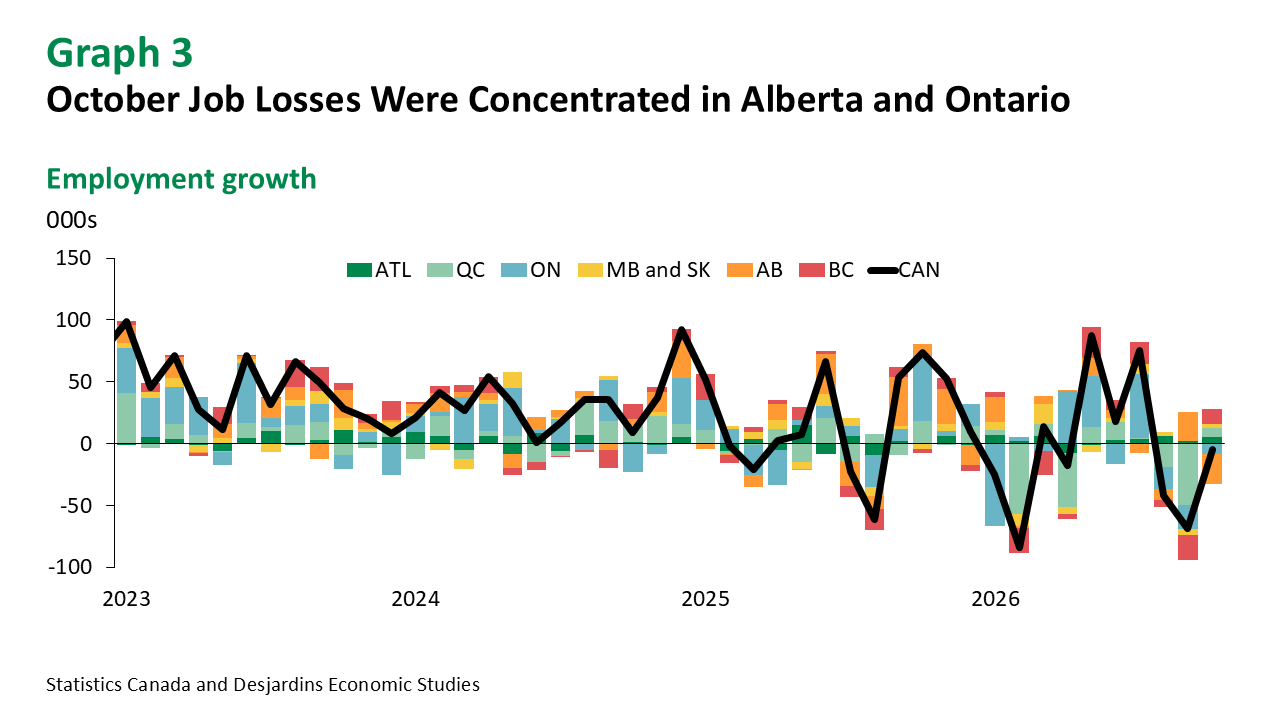
Regional performance remained uneven (graph 3). Alberta shed 24k jobs, while unemployment rose to 7.3% in both Alberta and Ontario. Quebec’s labour market stabilized after losing 68k jobs in August and September, while British Columbia added 12k.
Implications
The labour market is losing momentum, but the slack is building through slow hiring rather than layoffs. Our Q3 and early Q4 nowcasts point to a slightly weaker outlook than the BoC’s October MPR, but the economy has not strayed far from the Bank’s script. With officials focused on keeping high energy prices from spreading into broader inflation, we expect the BoC to raise its policy rate another 25 basis points in December.