
Desjardins Debit Card
Use your debit card for seamless in-store purchases and ATM and AccèsD transactions.
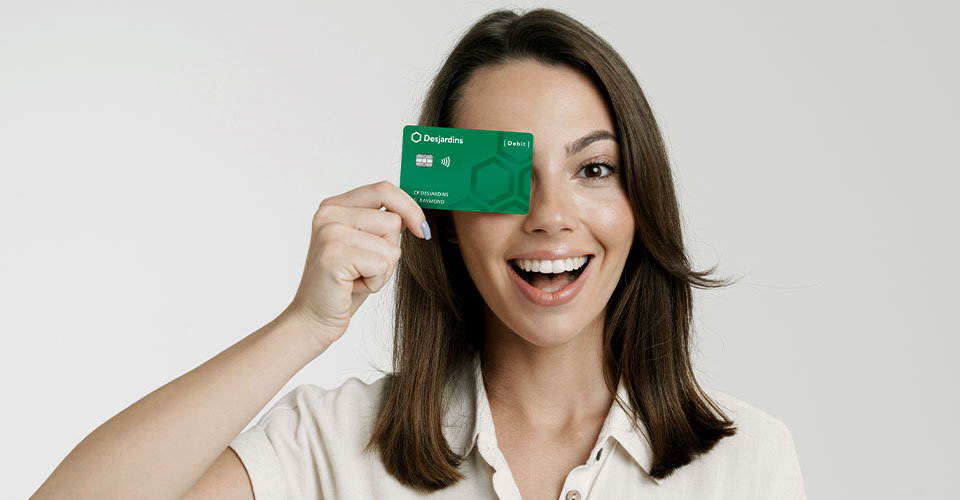
What's a debit card?
You can get a free Desjardins Debit Card upon request. In some cases, you may be required to pay a fee, such as when you request an additional card.
What's the difference between a debit and a credit card? Although both can be used to pay for purchases, a debit card links to your account and lets you spend your own money immediately, while a credit card lets you borrow money now that you'll have to pay back later.
You can also use your debit card number to log in to AccèsD and manage your finances online.
How to use your debit card
When you receive your first Desjardins Debit Card, call us at 1-800-224-7737 Phone number of customer service for Canada and the US. This link opens your phone app. (1-800-CAISSES) or go to a caisse or branch to activate it.
To pay for purchases, insert your card into the terminal and enter your personal identification number (PIN). There are a number of other ways to use it:
Contactless payment
Pay for purchases of up to $250 with one tap wherever Interac Debit® contactless payment is available.
Mobile payments
Add your debit card to your e-wallet and pay with Apple Pay® or Google Pay®.
Cash payments
Prefer to use cash? Use your debit card to withdraw or deposit money at an ATM or at the teller counter.
Pay with contactless payment
1. Get ready to pay
Look for the 4 arcs of the contactless payment symbol on the payment terminal.
2 2. Tap your card
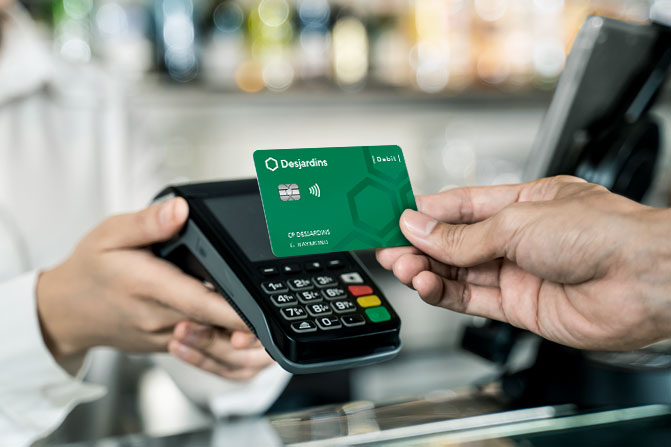
Place your debit card or mobile phone in the designated zone close to the secure reader.
3. Wait for confirmation
Wait for the terminal to beep or display an approval message. The money is deducted from your account immediately.
Good to know
Once you reach $400 in contactless transactions, you'll need to insert your card in the terminal and enter your PIN on the keypad to increase the security of your card.
Direct payment and ATM withdrawal limits
Daily limits on direct payments using the chip or on contactless payments may be different from those for ATM withdrawals. There are 2 different types of daily limits.
- A permanent limit is the maximum amount per day you can use to make purchases, purchases with withdrawal or standard ATM withdrawals.
- A temporary limit is the maximum amount per day you can use for a limited period of 1 to 5 days to cover upcoming purchases, purchases with withdrawal or ATM withdrawals that exceed your permanent limit.
If the ATM or merchant payment terminal has its own limit that's lower than the transaction limit on your account, the lower limit will be applied.
View or modify your daily limits
Personalize your daily limit for debit card purchases and ATM withdrawals to better meet your needs. You can view your limits and increase your temporary limit on AccèsD.
View your limits
- Choose the account.
- Select Information..
- Select ATM withdrawal limit or Direct payment limit.
Change your temporary limit
- Choose the account.
- Select Information.
- Under Daily limits, select ATM withdrawal limit or Direct payment limit.
- Under Temporary limit, select Enable.
- Fill in the fields and select Continue.
- Read the terms of use, then select Accept. You'll get a confirmation message.
If the feature is unavailable, you need assistance or want to change your permanent limit, call us at 1-800-224-7737 Phone number of customer service for Canada and the US. This link opens your phone app. (1-800-CAISSES)
Direct payment limit using the chip or contactless
payment
| Interac Debit direct payment limit using the chip | Amount |
|---|---|
| Limit per transaction | Your default or personalized limit |
| Default permanent daily limit | $1,000 |
| Personalized daily limit | Between $0 and your available account balance |
| Interac Debit contactless payment limit | Amount |
|---|---|
| Limit per transaction | $250 |
| Default permanent daily limit | $1,000 |
| Personalized daily limit | Between $0 and your available account balance |
ATM withdrawal limit
You can use your debit card to make withdrawals at ATMs within Canada and abroad. For more information on fees, see the Service fees page.
| Within Canada - Desjardins or Interac network ATMs | Amount |
|---|---|
| Limit per transaction | $1,000 |
| Default permanent daily limit | $1,000 |
| Personalized daily limit | Between $0 and $2,500 |
| Within Canada – AccuLink® network | Amount |
|---|---|
| Limit per transaction | $300 |
| Default permanent daily limit | $1,000 |
| Personalized daily limit | Between $0 and $2,500 |
| Internationally – PLUS* network | Amount |
|---|---|
| Limit per transaction | $500 |
| Default daily limit | $1,000 |
| Personalized daily limit | Between $0 and $2,500 |
7 tips to protect your debit card
The electronic chip, transaction limits and PIN are measures that enhance the security of your debit card transactions. You can also help keep your account secure by following a few simple rules.
- Never lend your card or give your PIN to anyone.
- Memorize your PIN. Don't write it down anywhere—especially on your card.
- Always keep your eye on your card during transactions.
- Hide the keypad from view when entering your PIN.
- Don't enter your PIN a second time without first checking that the previous transaction was cancelled.
- At the end of the transaction, take your card and get a transaction receipt.
- Beware of phone scams.
Fraud protection
- Security alerts by text message if we detect unusual activity on your account
- Zero Liability if fraudulent transactions are made with your card
- Desjardins Identity Protection to safeguard your assets and support you if your identity is stolen
Useful information
FAQ
How do I get a debit card?
If you already have an account with us, call us at 1-800-224-7737 Phone number of customer service for Canada and the US. This link opens your phone app. (1-800-CAISSES) to get your card, or visit a caisse or branch.
Your first debit card is free when you open an account. Fees apply for additional cards.
You must have an account with us to get a debit card. See the Everyday account page to learn more.
I left my debit card in an ATM. What should I do?
If you forget your debit card at an ATM, call us at 1-800-224-7737 Phone number of customer service for Canada and the US. This link opens your phone app. (1-800-CAISSES). For security reasons and to protect your account, we may have to destroy your card and send you a new one.
What do I do if I forgot my PIN or if my debit card is blocked after 3 incorrect PIN attempts?
If you forgot your PIN or your debit card is blocked, you’ll need to come to a caisse or point of service with 2 valid pieces of ID, one of which must have your photo and signature. These can include your driver’s licence, your health insurance card or a valid passport.
For security reasons, your debit card will be blocked if you enter your PIN incorrectly 3 times in a row. If you can't come to us, contact us at 1-800-224-7737 Phone number of customer service for Canada and the US. This link opens your phone app. (1-800-CAISSES) and we'll replace your card remotely.
How do I change my debit card PIN?
You can change your PIN 24/7 at any of our ATMs by following these steps:
- From the main menu, select Balance, statement, PIN change or repayment.
- Select PIN change.
- Follow the instructions.
You can also change your PIN at a caisse or branch. Alternatively, you can call us at 1-800-224-7737 Phone number of customer service for Canada and the US. This link opens your phone app. (1-800-CAISSES) to replace your card and get a new PIN by mail.
Can I use my debit card when I travel outside Canada?
Yes, you can use your debit card when travelling abroad. You don’t need to let us know when you’re travelling.
Look for PLUS* network ATMs. The PLUS network is like Canada's Interac network. It accepts PINs of 4 to 13 characters. Enter your 5-digit PIN as usual.
To learn more about foreign ATM fees, see the Service Fees page.
In the US, you can also withdraw money from ATMs in the NYCE® network. Direct payment is also accepted at more than 2 million businesses affiliated with NYCE.
You should always plan an alternative way to get local currency while you're travelling. Contact your caisse or branch Link to the location finder to find out about available currencies before you travel.